
Jacob Bowman
Most B2B lead lists are dead before a single email goes out. Wrong targeting, unverified data, no enrichment, no scoring. I have run over 3,000 campaigns across 50+ clients and generated more than $45M in pipeline. The difference between campaigns that fill calendars and campaigns that produce nothing almost always starts with the list.
This guide covers exactly how to build a B2B lead list that converts, step by step, with the tools, benchmarks, and real campaign data we use at OutboundLeads.
What Makes a B2B Lead List Actually Convert
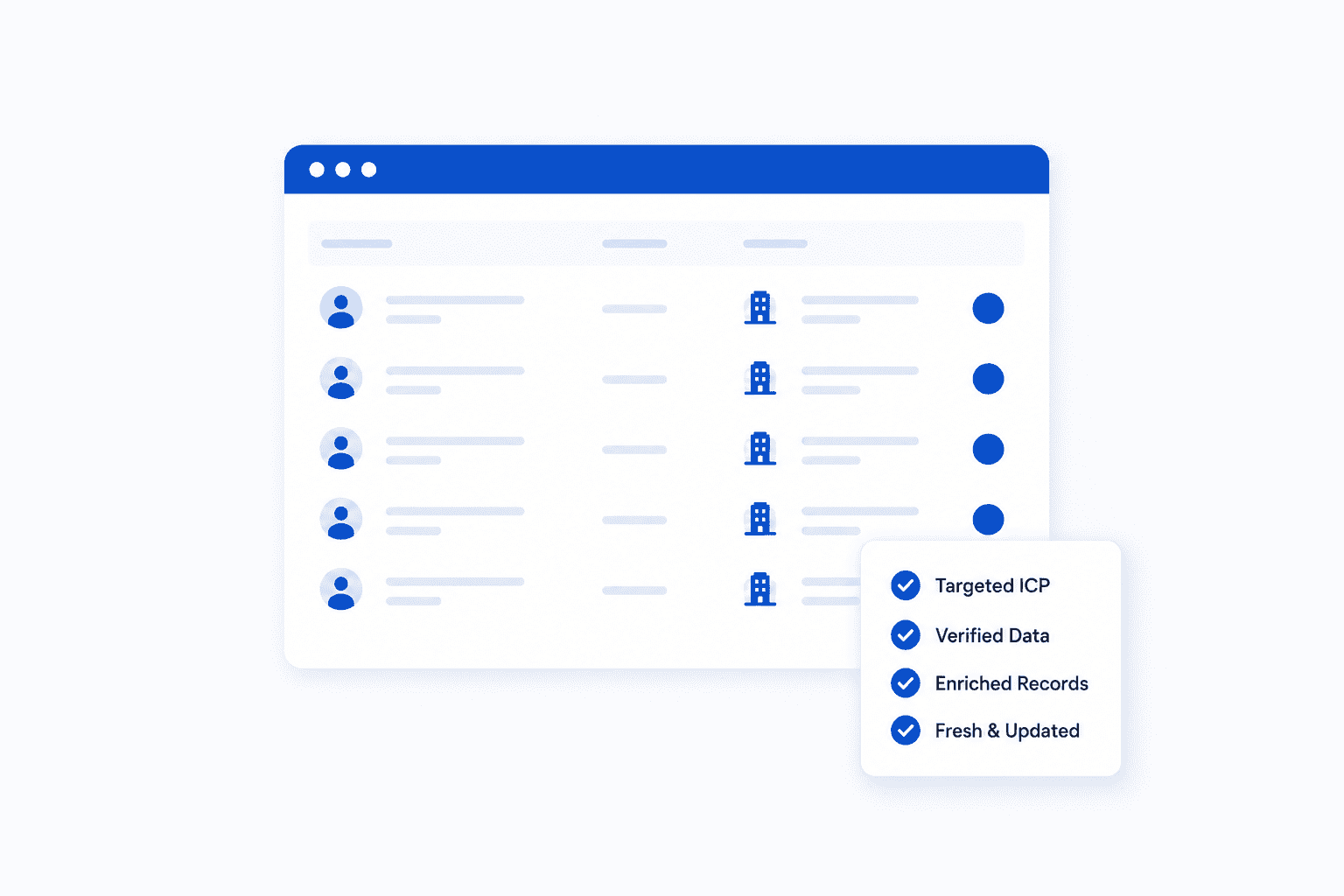
A lead list is not a spreadsheet of names. It is a curated, verified, enriched asset that connects your outbound system to real buyers with real intent. Four properties separate lists that produce pipeline from lists that burn budget:
Targeted. Every contact matches a specific, data-backed ICP. Not "tech companies with 50 to 500 employees." Narrow enough that one email copy resonates with every person on the list.
Verified. Every email address confirmed deliverable within the last 30 days. Bounce rates above 2% damage your sender reputation and push future sends into spam.
Enriched. Each record has enough context to personalize outreach: direct dial, LinkedIn URL, tech stack, company revenue, headcount, and recent trigger events.
Fresh. B2B contact data decays at roughly 2% per week. A list clean when you built it three months ago has already lost 25 to 30% of its accuracy.
Miss any one of these and reply rates drop. Miss two or more and you are actively damaging deliverability for every campaign running on that infrastructure.
Step 1: Define Your ICP Before You Pull a Single Contact
The most expensive mistake in outbound is building a list before you have a precise Ideal Customer Profile. Most founders think they have one. They do not. They have a target market, which is not the same thing.
An ICP is a data-backed description of the companies where you consistently win, close fastest, and retain longest. Not who you want to sell to. Who you have already sold to successfully. Start with your CRM. Pull every closed deal from the last 90 to 120 days. Flag the ones who paid on time, got results, and stayed. Look for patterns across that cohort. That is your ICP. We cover this in depth in our ICP guide.
For list building specifically, these are the attributes that actually determine whether targeting works:
Attribute | Why It Matters | Example Filter |
|---|---|---|
Industry | Determines whether your copy and offer resonate at all | B2B SaaS, FinTech, Professional Services |
Headcount | Signals budget authority and buying process complexity | 25 to 250 employees |
Revenue | Confirms they can pay for what you offer | $2M to $50M ARR |
Tech stack | Positions your offer relative to tools they already use | HubSpot users, Salesforce users |
Sales team size | Confirms there is an outbound motion to support | At least 2 dedicated sales reps |
Buying trigger | Signals active intent and timing relevance | New VP of Sales hire, recent funding, rapid hiring |
Prior outbound experience | Clients who have run outbound before close faster and churn less | Has used Apollo, ZoomInfo, or a prior outbound agency |
If your ICP describes 500,000 companies it is not specific enough. A company at 30 employees and one at 400 are at completely different stages. You cannot send the same message to both and expect equivalent results. Our best-performing lists target segments narrow enough that one copy covers every contact on the list.
Before You Build Anything
Answer four questions first:
Who are you targeting?
Why that specific segment?
Why is your offer relevant to them right now?
Why should they respond instead of ignoring it?
If the answers are vague, the list will fail regardless of how clean the data is.
Step 2: Source From the Right Channels
No single data source gives you everything. Teams that consistently build clean, converting lists pull from multiple channels and layer them.
LinkedIn Sales Navigator
Still the highest-quality source for contact accuracy on names, titles, and company attributes. The limitation is that email and phone coverage from Sales Navigator alone is thin. Use it for sourcing and segmentation, then run every record through enrichment before touching it with outreach.
Use Boolean search to narrow by role, seniority, company size, industry, and geography. Save the search so new matches appear automatically as accounts meet your criteria. Prioritize contacts who have posted in the last 30 days. Recent activity signals engagement and higher likelihood to reply.
Intent Data Platforms
Bombora and G2 Buyer Intent surface companies actively researching solutions in your category right now. These are not cold leads. They are in-market. A mediocre offer sent at the right moment outperforms a great offer sent six months too late. Prioritize intent-flagged accounts above everything else in your sequence planning.
Industry-Specific Directories
Almost every industry has a public directory maintained by an association, trade body, or niche publication. These tend to be more accurate than broad databases because companies submit the information themselves. Instant Data Scraper can pull structured data from most directories in minutes. Run the output through enrichment and you have a high-accuracy seed list most competitors are not working from.
Your Own CRM
The most overlooked source. Most sales teams have hundreds of leads sitting dormant that were never worked past one or two touches. A prospect who said "not right now" six months ago may be actively evaluating today. Before spending on new data, audit what you already have. Cold leads from 90 to 180 days ago are worth revisiting with a fresh offer.
Inbound Leads and Website Visitors
Always go to the top of the list. Someone who filled out a form, downloaded content, or booked and did not show has already expressed intent. Build a re-engagement process for these contacts with copy that references their prior interaction. Treating inbound leads the same as cold outbound contacts wastes your warmest opportunities.
Do Not Buy Pre-Built Lists
Purchased lists from data brokers are shared, stale, and almost never match your ICP. Deliverability on purchased lists averages 50 to 60%. You will damage your sender reputation before a single real campaign goes out.
How Many Contacts Do You Need?
Work backwards from your meeting target. Our benchmark across campaigns is roughly one booked meeting per 300 emails sent on a well-built list with a tested offer.
Goal | Calculation | Result |
|---|---|---|
10 booked meetings/month | 10 x 300 emails per meeting | 3,000 emails sent |
Buffer for bounces and bad data | 3,000 + 20% | 3,600 raw contacts needed |
Positive reply to meeting conversion | 1 in 5 interested leads should book | 50 positive replies needed to hit 10 meetings |
If you are not hitting one meeting per 300 emails, sending more volume is not the answer. It scales the problem. Fix the targeting or the offer first.
Step 3: Enrich Every Record
Raw sourcing gives you a company name and a contact title. Enrichment gives your reps what they need to personalize outreach and decide whether to pursue: verified work email, direct dial, LinkedIn URL, tech stack, company revenue, headcount, and recent trigger events.
Why Single-Source Enrichment Falls Short
Most teams enrich from one provider. No single provider covers the full B2B universe. Coverage varies by region, industry, and company size. Single-source enrichment typically delivers 60 to 70% email fill rates with 80 to 85% accuracy.
Waterfall Enrichment
Waterfall enrichment routes each record through multiple providers in sequence. If Provider A returns a verified email the record is done. If not, it moves to Provider B, then C. A well-built waterfall across 10 to 15 providers delivers 95 to 98% fill rates at a lower cost per record than any single source. Clay makes this buildable without custom engineering. We use it for every client campaign.
Metric | Single Source | Waterfall (10 to 15 providers) |
|---|---|---|
Email fill rate | 60 to 70% | 95 to 98% |
Email accuracy | 80 to 85% | 95 to 98% |
Phone fill rate | 25 to 40% | 55 to 70% |
Fields per record | 5 to 8 | 15 to 25 |
Field | Why You Need It | Best Source |
|---|---|---|
Verified work email | Without this nothing else matters | |
Direct dial or mobile | 3x higher connect rate than switchboard numbers | |
LinkedIn URL | Required for multi-channel sequences | |
Exact job title | Validates seniority and enables title-level personalization | |
Tech stack | Allows positioning relative to tools they already use | |
Company revenue range | Confirms buying capacity before outreach begins | |
Recent trigger events | Enables specific, timely first lines that are not generic | Crunchbase, LinkedIn company feed |
Step 4: Verify Emails and Phone Numbers
Enrichment fills the fields. Verification confirms they are accurate and safe to send to. Even after enrichment from a reputable provider, 5 to 15% of addresses in any given list can be outdated, role-based, or pointing to defunct domains.
Sending to unverified addresses is not just inefficient. A bounce rate above 2% signals to inbox providers that your sending domain is low quality. Once flagged, future sends land in spam regardless of how good the copy is. This compounds over time. We covered this in our guide on why cold emails go to spam.
A proper verification check covers: syntax validation, domain verification, MX record validation, mailbox existence via SMTP ping, catch-all domain detection, and disposable email flagging.
Run lists through at least two tools in sequence. BounceBan is strong on catch-all addresses. DeBounce adds blacklist and DNS checking. ZeroBounce adds activity scoring to confirm the inbox has been recently used. Running all three catches what any single tool misses.
Timing Is Critical
Verify immediately before sending, not when you first build the list. Someone who verified clean two months ago may have changed jobs or had their email deactivated. If you build the list in January and launch in March, re-verify in March.
Step 5: Score and Segment Your List
Once the list is clean and enriched, decide who gets worked first and how. Not every verified contact has equal conversion potential. Scoring turns a flat list into a prioritized queue.
Criterion | Max Points | Scoring Logic |
|---|---|---|
ICP fit (industry + size + revenue) | 40 | Strong match = 40, partial = 20, weak = 5 |
Title and seniority | 25 | VP / Director = 25, Manager = 15, IC = 5 |
Buying signals present | 20 | Funding + key hire = 20, one signal = 10, none = 0 |
Data completeness | 15 | Email + direct dial + LinkedIn = 15, email only = 5 |
Segment into three tiers based on score:
Tier A (80 to 100): Strong ICP fit, buying signals present, full data. Personalized multi-channel sequences with rep attention. 60% of outbound effort goes here.
Tier B (50 to 79): Partial fit or incomplete signals. Semi-personalized sequences with automated follow-up.
Tier C (below 50): Weak fit or missing data. Deprioritize. Sending more to Tier C skews your campaign metrics and makes benchmarks look worse than they are.
Step 6: Maintain the List Ongoing
A lead list is not a one-time project. It is a living asset that decays continuously. B2B contacts change jobs every 2.7 years on average. That is roughly 2% of your list going stale every week. Build once and forget and by month six you are working a list that is 50% unreliable.
Task | Frequency | Why |
|---|---|---|
Re-verify all email addresses | Monthly | Contact data decays 2% per week |
Re-enrich records with missing fields | Monthly | Provider coverage improves over time |
Remove bounced and unsubscribed contacts | After every send | Prevents repeat bounces that compound reputation damage |
Add new ICP-matching contacts | Weekly | Keeps pipeline volume consistent |
Deduplicate CRM records | Monthly | Prevents the same contact receiving two sequences |
Full ICP recalibration | Quarterly | Your best client profile evolves as you close more deals |
Warning signs that a list is decaying: bounce rate above 2%, reply rates dropping on segments that previously performed, or increasing "this person no longer works here" auto-replies. When those signals appear, stop sending and re-verify. Adding volume to a decaying list accelerates the damage.
The Offer Has to Match the List
A clean, well-sourced list with a weak offer will not convert. You can have the best product in your category and still lose to a competitor with an average product and a better lead magnet. A compelling offer pulls response where everything else fails. We come to the table with at least five offer variants for every new client campaign. We test them, track conversions, and iterate until one pulls consistently.
The metric that tells you whether the offer is working is not reply rate. It is conversion from positive reply to booked meeting. If 20% of replies are saying they are interested but almost none are booking calls, the offer structure is the problem. Not the list. Not the copy.
Common Mistakes We See Every Week
Scaling Volume Before the Base Metrics Work
If you are getting 2 meetings from 10,000 emails, scaling to 100,000 emails gets you 20 meetings. But the fact that it takes 10,000 emails to get 2 meetings is the actual problem. Scaling a broken campaign only scales the damage. Fix reply rate and positive reply to meeting conversion first. Then scale.
Reporting on Reply Rate Instead of Meetings and Revenue
Reply rate tells you whether people read the email. It does not tell you whether the campaign is working. The metrics that matter are meetings booked, pipeline created, and revenue per meeting. We saw this with a client who came to us after paying a previous agency $20,000 per month for four months. They had reply rates in their reports. They had five total booked calls across four months. The agency never surfaced anything downstream of the reply because the downstream numbers were the problem.
Ignoring Timing and Trigger Events
We ran a campaign off a list of 2,000 companies in a seasonal industry. We timed the outreach to arrive ahead of their highest-revenue season when the problem we were solving would be most acute. That campaign converted over $30,000 in MRR from 2,000 targeted contacts. More than $175,000 in LTV from a single well-timed list. The list was not large. It was precisely timed and precisely targeted.
Using Infrastructure That Burns Out
In early 2026, most accounts built on Azure panel setups got mass-banned overnight. We tracked it in real time through bounce rate spikes in our warmup pool. Every client on those setups lost their infrastructure in a single wave. We were not affected because we have used Zapmail for two years. Genuine Google account setups. Not legacy accounts, not edu panels, not cheap SMTP mailboxes. Cheap infrastructure costs more when it fails than reliable infrastructure costs upfront.
Red Flags to Watch When Evaluating Any List Source
Red Flag | What It Signals |
|---|---|
Single database, no enrichment waterfall | 60 to 70% email accuracy at best. Expect high bounce rates. |
No verification step before sending | Sender reputation damage within weeks |
List built more than 30 days ago, no re-verification | Up to 8% of contacts already stale |
Bought from a list broker or reseller | Shared data, GDPR risk, no ICP match |
No trigger event or timing layer | Outreach arrives with no relevance to the contact's current situation |
No scoring or segmentation | Tier C contacts burn budget and skew all campaign benchmarks |
Frequently Asked Questions
What is the 95-5 rule for B2B?
The 95-5 rule states that only 5% of your total addressable market is actively in-market and ready to buy at any given moment. The other 95% are not in a buying window. This is why list quality matters more than list size. Sending to 10,000 random contacts will not outperform sending to 500 people who are genuinely evaluating right now. Intent signals and trigger events are how you identify which bucket your prospects fall into before you send a single email.
What is the rule of 7 in B2B?
The rule of 7 says a prospect needs to encounter your message at least seven times before taking action. In outbound, this is why a single cold email almost never converts. At OutboundLeads, we run a 9-touch sequence across email, LinkedIn, and phone over roughly 21 days. Multi-channel follow-up is not aggressive. It is how outbound actually works. The full sequence structure is in our follow-up system guide.
How do you convert B2B leads into business?
The fastest path from lead to signed client is a follow-up system that treats interest as urgent. Across our campaigns, 60 to 70% of all booked meetings come from follow-up sequences, not the first email. When a lead responds, reach out within hours with a single clear ask. Interest fades fast. Speed of deployment is a revenue lever most teams ignore.
What is the best way to generate B2B leads?
In 2026, outbound with a verified, enriched lead list built from a precise ICP is still the fastest way to generate B2B pipeline. Cold email and LinkedIn sequences can produce meetings in weeks. Inbound through content and SEO takes months to compound. The two are not mutually exclusive, but for most B2B businesses trying to grow now, outbound is the lever that moves fastest when the list, offer, and infrastructure are built correctly.
How large should a B2B lead list be?
Size is the wrong question. Quality is the question. A list of 500 verified, enriched, well-targeted contacts outperforms 5,000 unverified contacts pulled from a single database every time. Work backwards from your meeting target, figure out how many sends you need, and build to that number with a 20% buffer for bounces and bad data.
How often should you update a B2B lead list?
Re-verify email addresses monthly at minimum. For high-volume campaigns, weekly. Add new ICP-matching contacts every week. Do a full ICP recalibration quarterly. Contact data decays at roughly 2% per week. A list accurate when you built it three months ago has already lost 25 to 30% of its reliability.
We've booked meetings for 50+ B2B teams. You're next.
Most agencies hand you a CSV. We hand you meetings.
3,000+ campaigns. $45M+ in pipeline. 20,000+ leads generated. Book a call and let's see if we're a fit.