
Jacob Bowman
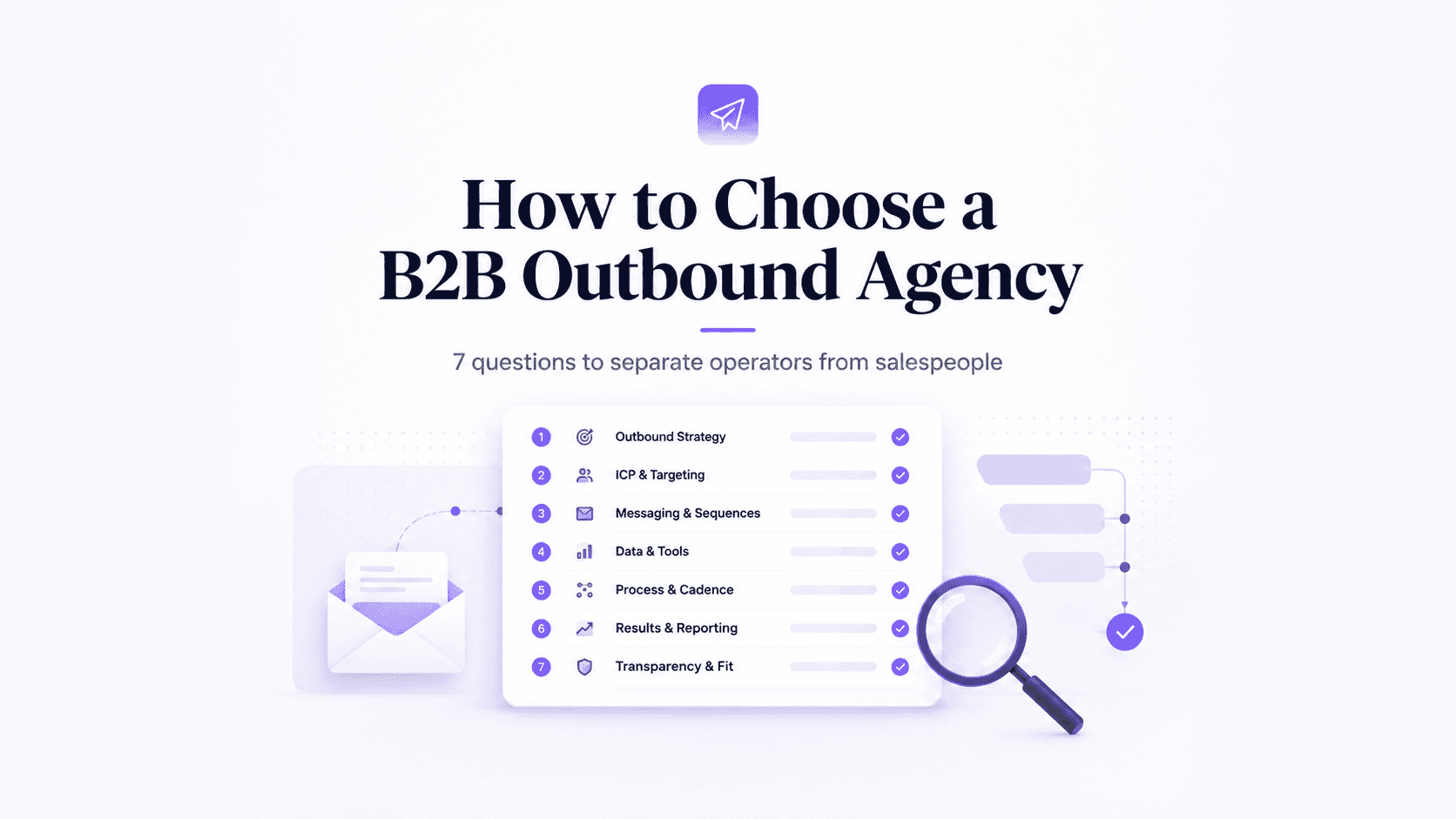
How to choose a B2B outbound agency: most GTM leaders ask this question after getting burned. One company paid $20,000 a month for four months and received five booked calls. That is $100,000 spent for five meetings. Another paid $30,000 a month for nine months with almost nothing to show for it. These are not edge cases. They are what happens when companies evaluate agencies based on a polished pitch instead of the right questions.
The barrier to entry in the outbound agency space is effectively zero. Anyone can build a website, list fake case studies, and start taking retainers tomorrow. The result is a market full of agencies that are better at selling themselves than running campaigns. Most of the companies that end up at OutboundLeads came from a bad prior agency experience. They lost months of time, burned budget, and damaged their brand in their target market before finding an operator who actually knew what they were doing.
This guide gives you the exact framework to separate real operators from good salespeople: seven specific questions, what a credible answer sounds like, what a red flag answer sounds like, and the benchmarks you should hold any agency to before, during, and after signing. OutboundLeads has run 3,000+ campaigns across 50+ clients and generated $45M+ in pipeline. The numbers in this guide come from that operational data, not from generic industry estimates.
Question 1: What Does Your First 90 Days Look Like?
This is the fastest way to separate an operator from a salesperson. The answer tells you whether the agency understands the actual mechanics of cold outbound or is pattern-matching to what sounds credible.
What Month One Should Look Like
A credible answer breaks the engagement into three phases with specific milestones at each one. Weeks 1 through 4 are infrastructure and setup: domain purchasing, configuration, and warmup; email account setup through a real sending pool; ICP finalization; list building; email validation and data cleaning; copywriting, campaign architecture, and sequence design; and strategy alignment between both teams. No meetings should be promised in month one. The infrastructure alone takes the full first month to do correctly.
What Months Two and Three Look Like
Weeks 5 through 8 are early signal collection. Campaigns run at meaningful volume. The goal at this stage is data, not pipeline. You should see initial replies, early positive responses, and enough performance data across copy angles and segments to make the first round of adjustments.
Month three is when consistent results become the expectation. By this point there should be a clear picture of top-performing sequences, the segments that respond best, and a campaign iteration cycle running smoothly.
Red Flag Answer
"We'll have you up and running in two weeks" or any promise of meetings in the first 30 days. Anyone guaranteeing early results either doesn't understand outbound infrastructure or is telling you what you want to hear.
Green Flag Answer
A structured, phase-based breakdown that includes infrastructure ramp-up time, honest early signal expectations, and specific milestone definitions at 30, 60, and 90 days.
Question 2: What Metrics Do You Track and Report On?
If an agency answers this question with reply rate alone, end the conversation. Reply rate is a vanity metric. You can manufacture a high reply rate with sensationalist subject lines that generate angry responses. The only number that actually matters to your business is qualified meetings booked.
The Full-Funnel Metrics That Matter
A credible agency tracks the full funnel: emails sent, reply rate, positive reply rate, meetings booked, and ideally pipeline generated. Positive reply rate is the signal that separates a working campaign from a noise machine. The benchmark to demand is that at least 20% of all replies should be positive or interested. If a campaign is getting 8% total reply rate but only 5% of those are positive, the targeting is off or the offer is not landing. That is a different problem than a campaign getting 4% reply rate with 30% positive replies, and a good agency will tell you which problem you have and what the fix is.
Meeting conversion is the next layer. One in five interested replies should convert to a booked meeting at minimum. If that number is below 20%, the issue usually lives in the follow-up sequence or the initial response handling, not the cold email itself.
Red Flag Answer
"We report on reply rates and deliverability weekly." No mention of positive reply rate or meetings booked.
Green Flag Answer
Full-funnel reporting covering sent volume, bounce rate, reply rate, positive reply rate, meeting conversion, and pipeline. Bonus points if they can explain what each metric tells them about campaign health and what actions each threshold triggers.
Question 3: What Email Infrastructure Do You Use and Why?
This question exposes more about an agency's actual competence than almost anything else. Deliverability is not a feature. It is the foundation everything else is built on. If your emails are not landing in inboxes, no other element of the campaign matters.
What a Real Deliverability Stack Looks Like
Ask them to name their inbox provider and explain the reasoning behind the choice. A real operator should be able to discuss genuine Google account setups, domain warmup protocols, DMARC and SPF/DKIM configuration, sending patterns, and how they monitor placement. Google's bulk sender requirements raised the technical bar significantly in 2024, and agencies that have not updated their infrastructure since are running a compliance risk on every campaign. Deliverability is an active infrastructure discipline, not a setup checkbox.
The Infrastructure Risk Most Buyers Miss
The specific risk to ask about: Azure panel setups and legacy edu accounts. These inbox configurations are cheaper to operate but carry a critical failure mode: they get wiped in mass bans. When that happens, you lose every domain that has been built up, every warmup period, and weeks of forward progress. OutboundLeads has used Zapmail for over two years with zero mass bans while agency operators running Azure panel setups have had their entire sending infrastructure wiped out. The upfront cost difference is not a savings. It is a time bomb.
If they cannot explain their deliverability stack with specifics, walk away. Vague answers here mean one of two things: they are cutting corners, or they do not understand the infrastructure well enough to defend the decisions they made. Neither is acceptable. See more on the technical side in this breakdown of why cold emails go to spam and how to fix it.
Red Flag Answer
"We use industry-standard tools" with no specifics. Any mention of Azure panels or edu account setups. No discussion of domain warmup timelines.
Green Flag Answer
Named inbox provider, explanation of why, warmup timeline, bounce rate monitoring process, and what happens if deliverability degrades.
Question 4: How Do You Build and Validate Lead Lists?
List quality determines the ceiling of every campaign. A weak list with great copy still produces poor results. The question is whether the agency treats list building as a rigorous, multi-step discipline or a data pull they get done quickly before moving to the part they consider more important.
What a Mature List Building Process Covers
A credible answer covers at minimum: ICP definition and firmographic targeting, data sourcing from enriched databases, validation before anything hits a sending sequence, and bounce rate monitoring as an ongoing signal. Tools like Clay for data enrichment and BetterContact for contact-level enrichment are legitimate signals that the agency is running a modern stack. Validation tools like EmailGuard should be part of the process before a single email goes out. If their answer is "we pull from Apollo and send," the list building process is not mature enough to deliver consistent results. Building a B2B lead list that converts requires enrichment, validation, and segment-level targeting decisions at every stage.
Red Flag Answer
Single-source data pull with no mention of enrichment, validation, or bounce rate management. No discussion of segment-level targeting decisions within the ICP.
Green Flag Answer
Multi-step process covering ICP definition, data sourcing, enrichment, validation, and ongoing list hygiene with specific tools named at each stage.
Question 5: How Do You Handle a Campaign That Isn't Working?
Every real operator has run campaigns that did not work. The difference between an agency worth hiring and one that will burn your budget is what they do when that happens. Do they adapt systematically, or do they stall and make excuses?
How Competent Agencies Diagnose Problems
The credible answer describes a specific diagnostic process. They look at reply rate, positive reply rate, and meeting conversion separately, because each tells you something different about where the breakdown is occurring. A high reply rate with low positive reply rate points to targeting or offer problems. A solid positive reply rate with low meeting conversion points to follow-up sequence or response handling issues. A low reply rate across the board points to deliverability or ICP problems. An agency that cannot tell you which problem they are solving is not actually solving anything.
How Fast Decisions Should Happen
OutboundLeads data shows campaigns can be killed or pivoted within 24 hours based on reply volume and sentiment signals. At least half of all replies to a first cold email arrive within the first 24 hours, which means a competent agency does not need weeks to diagnose a failing campaign when they have sufficient send volume. They should be making data-driven decisions fast, not asking you to "give it time."
Ask them directly: "What are the specific signals that tell you a campaign needs to be killed versus optimized?" If they have never killed a campaign, they are not being honest with you.
Red Flag Answer
"We'd give it more time" or "the market is saturated" without data to support the diagnosis.
Green Flag Answer
Specific signal thresholds for each type of underperformance, a defined iteration process, and evidence they have killed and rebuilt campaigns when warranted.
Question 6: Can You Show Me a Campaign That Failed?
Every agency has a polished case study deck. What separates an operator from a salesperson is whether they can show you a campaign that did not work and explain exactly what they learned and changed.
Why Failures Are a Credibility Signal
Real operators have failures. Running 3,000+ campaigns means running some that flopped, some that started wrong and needed a full rebuild, and some that revealed uncomfortable truths about a client's offer or ICP. An agency that only has wins is either not being honest or has not run enough campaigns to have meaningful data. OutboundLeads has documented campaigns where reply rates were strong but meeting conversion was near zero because the initial follow-up email was too long and gave prospects too many options to process. The fix was a complete sequence rebuild. That kind of specific, honest breakdown of failure is exactly what separates a credible operator.
What to Demand From Case Studies
Also ask for a recent case study from a company at your stage or in your space. Not just logos and percentage claims. Specific numbers, timeframes, and context. "We increased reply rates by 300%" without context is a marketing claim, not evidence.
Red Flag Answer
Only wins to show. Vague outcome statements with no specifics. Case studies from companies in completely different industries or stages with no explanation of transferability.
Green Flag Answer
At least one honest account of a campaign that failed, what signals identified the problem, what changed, and what the outcome was after the pivot.
Question 7: What Are Your Contract Terms and What Do I Own?
Contract terms tell you what an agency actually believes about their ability to deliver results. Agencies that lock you into 6 to 12 month contracts with no performance clauses know they cannot deliver. If they were confident in their execution, they would not need your budget guaranteed for a year regardless of outcomes.
Asset Ownership: The Question Buyers Forget to Ask
Ask specifically what you own at the end of the engagement: email domains, contact lists, sending infrastructure, campaign data, and sequence copy. Agencies that retain ownership of these assets are creating dependency by design. If you terminate, you lose months of warmup time and all the data you paid to generate. The assets your agency builds should belong to you.
Pricing Transparency and Hidden Costs
Ask about pricing transparency: what is included in the retainer, what triggers additional fees, and what the exact billing process is. Hidden costs and surprise fees after signing are a reliable preview of what communication will look like throughout the engagement. For a detailed breakdown of the full cost picture, including how outbound agency fees compare to building in-house, read this analysis of in-house SDR vs. outbound agency: true cost and ROI.
Red Flag Answer
Minimum 6-month lock-in with no performance terms. Ownership of domains and infrastructure retained by the agency. Vague answers about what is and is not included.
Green Flag Answer
Clear scope of what is included, transparent pricing, client ownership of all assets built during the engagement, and performance-based checkpoints with defined exit terms.
Cold Outbound Benchmarks: Reply Rate, Meeting Conversion, and Bounce Rate Standards
Most agency evaluation guides tell you what questions to ask. None of them tell you what a credible answer actually looks like in numbers. That gap is where companies get burned. They ask the right questions, hear answers that sound reasonable, and only realize later they had no baseline to score the response against.
Email Performance Benchmarks
Here are the specific benchmarks to use when evaluating agency answers and ongoing performance. These are operational minimums from OutboundLeads campaign data across 3,000+ campaigns.
Metric | Minimum Healthy Threshold | What It Tells You |
|---|---|---|
Reply rate | 3% to 8% depending on market and volume | Deliverability and targeting are functioning |
Positive reply rate | At least 20% of all replies | Offer and ICP are aligned |
Meeting conversion | 1 in 5 interested replies minimum | Follow-up and response handling are effective |
Emails to qualified meeting | 1 per 300 emails sent | Full-funnel efficiency is at a workable level |
Bounce rate | Under 3% consistently | List quality and validation are adequate |
Human responses per 10,000 contacts | At least 30, with 6 interested | Campaign is reaching decision-makers at volume |
Reply velocity | 50%+ arrive within 24 hours | Decisions can be made fast with sufficient volume |
When to Scale vs. When to Fix
Before scaling volume, all five email benchmarks above should be consistently met. Scaling before hitting these thresholds means spending more money to produce the same mediocre results at higher volume. Fix the system first. For a full breakdown of how to use these signals to build a scalable system, read this post on building a scalable follow-up system with real outbound data.
How Long Does It Take to See Results From a B2B Outbound Agency?
Consistent, qualified meetings should begin appearing by the end of month three. Month one is infrastructure: no campaigns run at scale, no results expected. Month two is early signal collection: campaigns launch at meaningful volume, initial replies come in, and the first round of optimization happens based on real data. Month three is when performance becomes the standard expectation.
Why Early Promises Are a Warning Sign
Any agency promising meetings in the first two to four weeks is either lying or does not understand what proper infrastructure setup requires. The agencies that skip warmup to show quick results are setting up a deliverability collapse two to three months in.
Why Outbound Is Not a Flat-Line Channel
One important caveat: outbound is not a perfectly consistent week-over-week channel. There are periods where meeting volume is high and cost per lead is low, and periods where things slow down for reasons that include messaging fatigue, buyer behavior shifts, competitor offer changes, or deliverability dips. A credible agency tells you when this is happening, explains what they believe is driving it, and shows you what they are testing to correct it. An agency that goes quiet or makes excuses is not an operator.
How Much Does a B2B Outbound Agency Cost?
Credible B2B outbound agencies typically charge between $5,000 and $15,000 per month depending on scope, send volume, and the level of strategic involvement required. Agencies pricing significantly below this range are cutting corners somewhere: cheaper tools, offshore labor with no oversight, or a volume business model where every client gets mediocre execution.
How to Actually Evaluate Pricing
The question is cost per qualified meeting booked. A $3,000/month agency that books zero meetings costs more than a $10,000/month agency that books four qualified meetings per month and generates pipeline that closes. Meeting quality tends to decline after month three when agencies are not held to defined criteria in writing, which is exactly why those terms need to be locked before signing. Evaluate pricing in the context of expected output and pipeline value, not the monthly retainer in isolation.
Outsource vs. Build In-House
For context on the full cost comparison between outsourcing outbound and building an in-house SDR function, including true fully-loaded costs, see the in-house SDR vs. outbound agency breakdown. For a comparison of leading outbound agencies currently operating in this space, see the 5 best outsourced SDR companies in 2026.
Red Flags That Disqualify an Agency Immediately
Some red flags are dealbreakers regardless of how good the rest of the conversation sounds. If any of the following appear, stop evaluating and move on.
Contract and Pricing Red Flags
They lock you into a 6 to 12 month contract with no performance clauses or exit terms.
Their pricing is significantly below market rate with no explanation of how they deliver the same output at lower cost.
They guarantee a specific number of meetings. No credible agency guarantees meeting counts because too many variables outside the agency's control affect conversion.
Metrics and Reporting Red Flags
They only talk about reply rates and never mention positive reply rate or meetings booked.
They cannot produce a case study with specific numbers, timeframes, and company context.
Their reporting cadence is monthly with no interim signals or dashboards.
Team and Experience Red Flags
They cannot name the person who will actually run your account and what their experience level is.
They have never worked with a company at your stage or in your space, and cannot explain how their approach translates.
The person selling you has no involvement in execution and cannot answer technical questions about how campaigns are built.
Their only GTM experience is running an outbound agency. They have never worked in sales, never built a pipeline themselves, and cannot speak to outbound from the perspective of the operator on the other side.
They are slow to respond during the sales process. This is a direct preview of communication quality once you have signed.
The Follow-Up Gap: Where Most Meetings Actually Come From
One of the fastest ways to identify whether an agency is serious is to ask how they think about follow-up. Across OutboundLeads campaigns, 60 to 70% of all meetings booked come from follow-up sequences, not the first cold email. An agency that treats follow-up as an afterthought is leaving the majority of your pipeline on the table.
What a Strong Follow-Up System Looks Like
A strong follow-up system runs 9 touches over 21 days across email, LinkedIn, and phone. Each touchpoint adds something new rather than repeating "just following up." The structure creates urgency without burning the relationship. LinkedIn has tightened connection request limits significantly, which makes sequenced, value-led follow-up across channels more important than ever rather than relying on volume blasts through a single channel.
What Offer Order Can Do to Results
The specific value of getting follow-up right: OutboundLeads tested a sequence where two lead magnets were offered in different orders across email one and email two. Switching the order of those offers produced a 600% increase in meeting bookings. The targeting had not changed. The copy quality had not changed. The offer order changed. That is what granular optimization of a follow-up sequence can produce.
Ask any agency you are evaluating to walk you through how they structure their follow-up sequences, how many touchpoints they run, and how they measure whether the sequence is performing. If they describe a 3-email sequence and nothing else, their follow-up is not built to capture the 60 to 70% of meetings that come from persistence and channel variety. For the full framework, see how OutboundLeads approaches building a scalable follow-up system.
Strong Agency vs. Weak Agency: Side-by-Side Comparison
Evaluation Area | Weak Agency | Strong Agency |
|---|---|---|
First 30 days | Campaigns live, meetings promised | Infrastructure only, no volume expected |
Metrics reported | Reply rate only | Full funnel: sends, bounces, replies, positive replies, meetings, pipeline |
Infrastructure | Azure panels or edu accounts, vague on setup | Real Google accounts, named inbox provider, warmup protocols documented |
List building | Single Apollo pull, minimal validation | Multi-source enrichment, validation before send, segment-level targeting decisions |
Campaign failures | Only wins to show | Specific failures documented with what was learned and changed |
Follow-up system | 3-email sequence, email only | 9 touches over 21 days across email, LinkedIn, and phone |
Contract terms | 6 to 12 month lock-in, agency owns assets | Performance checkpoints, client owns all domains and data |
Team transparency | Sales-only contact pre-signature | You meet the execution team before signing |
Underperformance response | "Give it time" or market blame | Specific diagnostic, data-driven pivot within 24 hours of signal |
FAQ: How to Choose a B2B Outbound Agency
What should I look for in a B2B outbound agency?
Look for an agency that can answer seven specific questions with data: how they structure the first 90 days, which full-funnel metrics they track, what their email infrastructure is built on, how they build and validate lead lists, how they handle a campaign that is not working, whether they can show you a campaign that failed, and what the contract terms and asset ownership policy are. Agencies that cannot answer each of these questions with specifics are not operators.
How long before an outbound agency produces results?
Consistent, qualified meetings should start appearing by the end of month three. Month one is infrastructure setup only. Month two is early signal collection. Agencies promising meetings in the first 30 days are skipping the foundation required for sustained performance. Any agency that needs to show you quick results by cutting warmup time is creating a deliverability problem they will blame on the market later.
What metrics should a B2B outbound agency report on?
A credible agency reports on the full funnel: emails sent, bounce rate, total reply rate, positive reply rate, meetings booked, and pipeline generated. Positive reply rate is the most important leading indicator. At minimum, 20% of all replies should be positive or interested. One in five interested replies should convert to a booked meeting. Reply rate alone tells you nothing about whether the campaign is actually working.
How much does a B2B outbound agency cost?
Credible B2B outbound agencies charge between $5,000 and $15,000 per month depending on scope, send volume, and strategic involvement. Pricing below this range typically reflects cut-rate infrastructure, offshore labor with no oversight, or a volume model where every client gets thin execution. Evaluate cost relative to qualified meetings booked, not the monthly retainer in isolation.
What questions should I ask before hiring an outbound agency?
Ask: What does month one look like specifically? What metrics do you track beyond reply rate? What inbox provider do you use and why? How do you build and validate your lead lists? What happens when a campaign is underperforming? Can you show me a campaign that failed? What are the contract terms and what do I own at the end? Any agency that deflects, generalizes, or cannot answer with data is not an operator.
What are the red flags when evaluating an outbound agency?
The clearest red flags: a 6 to 12 month lock-in with no performance clauses, guaranteed meeting counts, reporting that only covers reply rate, infrastructure built on Azure panels or legacy edu accounts, no documented failures in their case study portfolio, the agency retains ownership of your domains and data, and the person selling you cannot answer technical questions about how campaigns are built.
Should I outsource outbound or build an in-house SDR team?
The right answer depends on your stage, budget, and how fast you need pipeline. An outbound agency eliminates the time and cost of hiring, onboarding, and managing an SDR, and a good agency brings tested systems and campaign data from day one. An in-house SDR makes more sense once you have validated your ICP and offer and need to scale a proven system. For a full cost comparison, see the in-house SDR vs. outbound agency breakdown.
How to Hire a B2B Outbound Agency That Books Meetings
The companies that get results from outbound agencies are not lucky. They ask the right questions, demand real answers, and hold performance to a specific numerical standard before scaling budget or extending contracts. The seven questions above, combined with the benchmarks in this guide, give you that standard. Use them on every agency you evaluate, including OutboundLeads. If any agency cannot answer these questions with specificity and honesty, that is the answer.
OutboundLeads has run 3,000+ campaigns, generated $45M+ in pipeline for 50+ clients, and built every process described in this guide from operational data. If your outbound is running but not converting, that is a system problem. Book a strategy call and get a specific diagnosis of where the breakdown is.