
Aylin Bezirgan
In early 2026, a lot of cold outbound programs went dark overnight. Teams running Azure panel-based setups had their entire sending infrastructure wiped when Microsoft pulled the tenant accounts. Bounce rates spiked. Accounts were gone. Two to three weeks of progress, just gone.
We saw it coming. We had been tracking bounce rates inside our warm-up pool for months and identified the problem before it hit our clients. We knew because we were watching the signals. Most people don't watch the signals until something breaks.
That's the thing about deliverability. It almost never looks like a deliverability problem when it starts. It looks like your targeting is off. It looks like your copy stopped working. It looks like a soft month. By the time you trace it back to infrastructure, you've already lost clients or weeks of momentum you're not getting back.
This is the framework we've built across 3,000+ campaigns to make sure that doesn't happen.
Who this is for: Founders, GTM operators, and agencies running cold email at volume. If you're rewriting copy to fix reply rates when you haven't checked your infrastructure first, read this before you touch another sequence.
1. Your Emails Are Going Out. That Doesn't Mean Anyone Is Seeing Them.
Most teams think delivery and deliverability are the same thing. They're not, and that gap is where outbound programs go to die.
Delivery means the receiving server accepted the email. The mail truck dropped it off. Deliverability means it made it past the dog, through the front door, and onto the kitchen table where someone actually reads it. You can have near-100% delivery and still have 40% of your emails sitting in spam or promotions where no one ever sees them.
Metric | What it actually measures | What it does NOT tell you |
|---|---|---|
Delivery rate | Server accepted the email | Where it landed |
Inbox placement rate | Email hit the primary inbox | Whether anyone read it |
Open rate | Someone opened it (or an image loaded) | Real read rate. Apple MPP makes this number unreliable. |
Reply rate | Actual engagement | Whether your infrastructure is healthy |
In 2026 the average global inbox placement rate is 83.1%. Nearly 1 in 6 emails never reaches a human. Cold outreach runs on narrow margins. A 15-17% inbox miss rate doesn't just hurt your numbers. It breaks the math of the whole campaign.
Our internal benchmark: We target 1 qualified reply per 300 emails sent. When that ratio drops and copy and targeting haven't changed, infrastructure is the first thing we look at, not the last. For what happens once replies start coming in, we have a full guide on building a follow-up system that actually converts.
2. Infrastructure Sits at the Bottom of Everything. Remove It and Nothing Above It Works.
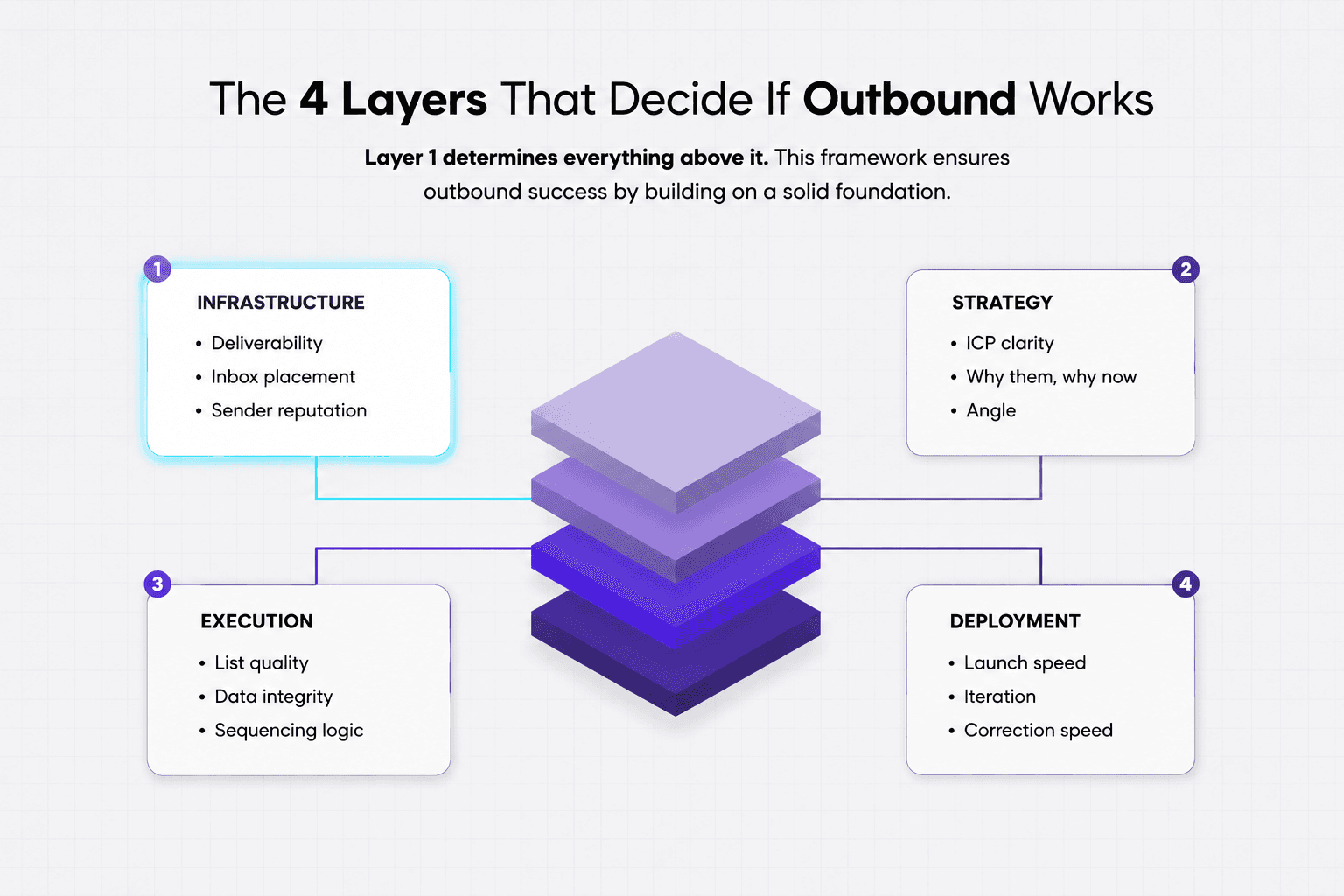
We break the outbound system into four layers. Every client we onboard gets audited at layer one before we write a single word of copy. Most agencies skip straight to layer three. That's why they struggle.
Layer 1, Infrastructure: Domain setup, authentication, account provisioning, sequencer. If this isn't right, nothing else matters.
Layer 2, Strategy: Who you're targeting, why them, what offer, and why they should respond.
Layer 3, Execution: List building, copy, lead magnets, tooling.
Layer 4, Deployment: How fast you reply to leads, how quickly you iterate campaigns, how well you manage changes.
You can have the sharpest copy in your category, a perfectly defined ICP, and an offer that should convert. None of it reaches anyone if your emails aren't landing in the inbox. The foundation has to be right first.
3. Three Decisions Made at Setup That You Will Pay For Later If You Get Them Wrong
Most deliverability problems aren't random. They trace back to one of three decisions made weeks or months earlier. I see teams make at least one of these wrong all the time, and then they wonder why results dropped.
1. Domain Registrar Quality
Cheap TLDs and low-reputation registrars get filtered harder. Use reputable registrars and set up dedicated sending domains, not your primary domain. If your main domain gets flagged it takes everything else down with it. New sending domains need 30-60 days of warmup before you touch production volume.
2. Account Reseller Quality
This is where most agencies cut corners and where it hurts the most. Azure panels, edu accounts, SMTP mailboxes, legacy setups. They all look cheaper upfront. And they all fail in the same ways. We've tested a lot of different infrastructure over the years. The only one we haven't had problems with is Zapmail, because they provide genuine Google Workspace accounts. Two-plus years, 50+ clients, zero mass account bans. I can't say that about anything else we've run.
3. Email Sequencer Reliability
Your sequencer controls how you send: velocity, warmup, consistency. A sequencer that lets you send erratically (500 on Monday, nothing for three days, then 1,000 on Friday) is training inbox providers to distrust your domain. Providers learn your patterns. Erratic ones look like spam operations. We use EmailBison because the sending behavior is consistent and provider-friendly. For the full stack we run, see our GTM tools breakdown.
What the Azure wipeout cost people: These teams paid less per inbox every month. When Microsoft pulled the tenant accounts they lost their entire setup, had to rebuild from zero, and lost 2-3 weeks of ramp time. If one client churned because of it, the savings were gone and then some. I promise you the amount you lose from client churn will always be more than whatever you saved running cheap infrastructure. It's not close.
4. SPF, DKIM, and DMARC Are Not Optional in 2026
This used to be something you could get away with skipping. You can't anymore. Google, Yahoo, and Microsoft all enforce bulk sender requirements now. If you're not configured correctly, you're not going to spam. You're being rejected before a human makes any decision at all.
Record | What it does | What breaks it | Status |
|---|---|---|---|
SPF | Tells receiving servers which IPs are authorized to send from your domain | Multiple SPF records on the same domain; more than 10 DNS lookups; adding new tools without updating it | Required |
DKIM | Cryptographic signature that proves the email came from you and wasn't altered | Key length under 2048-bit; not rotating keys at least once a year | Required |
DMARC | Ties SPF and DKIM together and tells providers what to do when something fails | Still sitting on p=none, which tells providers you're watching but doing nothing about failures | Required |
BIMI | Puts your logo in the inbox as a visible trust signal | Requires a VMC certificate; under 1% of senders have it | Optional |
Where Senders Actually Stand Right Now
Protocol | Adoption rate | What that means |
|---|---|---|
SPF | 94% | 6% of senders are still getting flagged at the most basic possible level |
DKIM | 90% | 1 in 10 senders can't prove their emails are actually coming from them |
DMARC | 72% | 28% have no policy layer. p=none does nothing to protect you. |
DMARC on p=none means you're watching but not acting. Inbox providers can see that. p=reject tells them you're serious. That's the standard now for anyone who cares about consistent inbox placement.
Quick audit before your next send: Pull up MXToolbox, check your SPF lookup count (has to be under 10), confirm your DKIM key is 2048-bit minimum, verify DMARC isn't still on p=none. Five minutes. We've caught issues at this step that would have killed entire campaigns.
5. Warmup Is Not a One-Time Setup. It's a Process and Most People Rush It.
New sending domains can't jump straight to volume. Inbox providers track your sending history. A domain that starts blasting 500 emails on day one looks exactly like every spam operation that's ever done the same thing, because most of them do.
Phase | Timeline | Daily volume | What you're building |
|---|---|---|---|
Ramp | Week 1-2 | 5-10 emails/day | Initial sending history |
Build | Week 3-4 | 20-40 emails/day | Consistent engagement signals |
Scale | Week 5-6 | 50-100 emails/day | Production-ready reputation |
Production | After week 6 | Per domain limits | Consistent daily cadence, no erratic spikes |
Erratic sending kills deliverability faster than almost anything else. 500 Monday, nothing Tuesday through Thursday, 1,000 Friday. Providers learn your behavior. That pattern looks like a spam operation because it usually is one. Consistent, predictable sends build the reputation that keeps you in the inbox.
Mistake people make with idle domains: Domain age doesn't build sending reputation. A 6-month-old domain that was never warmed will still perform worse than a 60-day-old domain that was warmed properly. Age doesn't give you a shortcut.
6. Cheap Infrastructure Isn't Actually Cheaper. The Bill Just Comes Later.
The pitch for cheap infrastructure is always the same: save money upfront. And then one day it fails, and you find out what it actually cost you.
Infrastructure type | Monthly cost | Failure risk | Recovery time when it fails |
|---|---|---|---|
Azure panels / shared SMTP | Lower | High. Ban waves hit the whole pool at once. | 2-3 weeks minimum |
Edu / legacy accounts | Very low | Very high. Sketchy setups that get flagged fast. | Full rebuild from zero |
Zapmail (genuine Google Workspace) | Higher | Near zero* | N/A |
"If we lose a client or two because cheap infrastructure wiped our sending setup, I promise you the amount we lost from those clients far surpasses whatever we saved by doing it the cheap way. It's not even close." - Jacob Bowman, Founder, OutboundLeads
One client at $5,000-$20,000 MRR churning because your infrastructure failed costs more than a full year of premium inboxes across your entire portfolio. The math on saving $200 a month does not survive one churn event.
7. By the Time Your Reply Rates Drop, the Problem Has Already Been Compounding for Weeks
Deliverability doesn't collapse in one day. It degrades. The signals show up early if you're watching, but most people aren't watching until something already broke. If your emails are already going to spam, start here: why cold emails go to spam and how to fix it. Then come back and build the monitoring layer that stops it from happening again.
The Numbers to Watch Every Week
Signal | Target | When to act | Why it matters |
|---|---|---|---|
Spam complaint rate | Under 0.1% | Hit 0.3% and Google blocks you. Full stop. | The single most weighted signal inbox providers use in 2026 |
Bounce rate | Under 2% | Sustained above 2% means list hygiene or infrastructure problem | Leading indicator. Fix it before it damages sender reputation permanently. |
Inbox placement rate | 87% or higher | Below 80% something is broken | Tells you whether your emails are actually being seen |
Warm-up pool health | Stable week over week | Any spike in pool bounce rates | How we caught the Azure collapse 5-10 days before it hit campaigns |
The Weekly Monitoring Checklist
Bounce rate trend by domain cluster, week over week, not just the absolute number
Spam complaint rate in Google Postmaster Tools. Flag anything trending above 0.08%.
Warm-up pool placement by provider. If Gmail is fine and Outlook is spiking, that's not noise.
Domain blacklist status via MXToolbox. Takes two minutes.
Reply-to-send ratio by inbox cluster. Outlook behaving differently than Gmail is a data point, not a coincidence.
Account age and rotation. No single domain should be carrying more volume than it was built for.
Outlook is the hardest inbox to crack. 75.6% deliverability versus Gmail's 87.2%. If your ICP is enterprise, you're sending heavily into Outlook. That's not a ceiling you accept. You beat it with tighter authentication, cleaner lists, and more conservative volume on Microsoft-bound sends.
8. Volume Is Not the Answer When the Foundation Is Broken
When campaigns underperform, the instinct is always to send more. I see it constantly. And it's almost always the wrong call when infrastructure or list hygiene is the real problem. Volume is an accelerant. If the foundation isn't solid, more volume means you're burning more of your addressable market with emails that aren't landing anywhere useful.
What you're seeing | Right move | Wrong move |
|---|---|---|
Reply rate dropping, copy hasn't changed | Check bounce rates, warm-up pool, domain reputation | Increase volume to compensate |
Everything benchmarking well | Scale across more sending domains | Stack more volume on fewer domains to cut costs |
Good reply rate, low meeting conversion | Fix the follow-up and the offer. That's the actual problem. | Assume it's a deliverability issue when it's not |
New campaign, no data yet | Kill or iterate within 24 hours with enough send volume | Wait weeks for more data before making a call |
Our benchmark: at least 30 human replies from 10,000 contacts, with at least 6 expressing real interest. Hit that and you have something worth scaling. If you're not hitting it, adding volume doesn't fix what's broken. It just burns more of the list.
Who should not be scaling right now: If you can't make outbound work at level one, you can't make it work at any other level. Fix the infrastructure and the offer first. Scale second.
9. 2026 Benchmarks and Why the Industry Averages Are Misleading
Most benchmarks are dragged down by programs that skip authentication and never clean their lists. The global average is not your target. Compare yourself to your vertical and to what well-run programs actually hit.
Metric | Something's wrong | Acceptable | Good | Excellent |
|---|---|---|---|---|
Inbox placement rate | Under 80% | 80-87% | 87-93% | 93% or higher |
Bounce rate | Over 5% | 2-5% | 0.5-2% | Under 0.5% |
Spam complaint rate | Over 0.3% | 0.1-0.3% | 0.05-0.1% | Under 0.05% |
Reply-to-send ratio (cold) | Under 1 per 1,000 | 1 per 500-1,000 | 1 per 300-500 | 1 per 100-300 |
Inbox Placement by Provider (2026)
Provider | Inbox placement rate | Difficulty for cold outreach | What drives it |
|---|---|---|---|
Google Gmail | 87.2% | Medium | Strict on complaint rate thresholds. Goes to zero tolerance fast. |
Yahoo Mail | ~85% | Medium | DMARC enforcement tightened post-2024 |
Apple iCloud | ~88% | Medium | MPP makes open rate data unreliable. Don't use opens as a deliverability signal here. |
Microsoft Outlook | 75.6% | High | Sweep feature, strictest filtering of any major provider |
What Well-Run Programs Do That Everyone Else Doesn't
They verify lists before every send. Programs using verified lists consistently hit 94%+ deliverability with under 3% bounce rates.
They spread volume across multiple sending domains instead of stacking it all on one.
They use genuine Google Workspace accounts, not SMTP, not panels, not legacy accounts.
They watch the slope of their spam complaint rate, not just the number. A program trending up 10% month over month at 0.12% is heading for trouble faster than a static 0.15%.
They rotate DKIM keys every year and audit SPF every time they add a new sending tool.
Deliverability Is Not a Setup Task. It Is the Operational Discipline That Keeps Your Pipeline Alive.
Deliverability problems almost never announce themselves. They look like a soft month. They look like a sequence that stopped working. They look like targeting that needs a refresh. By the time you've traced it back to infrastructure, the damage is already done.
The operators running consistent cold outbound aren't doing anything dramatically different in their copy. They treat infrastructure like an ongoing function, not something you configure once and forget. They watch the signals. They invest in quality inboxes. They don't try to save $200 a month and then wonder why a client churned.
We've run this framework across 3,000+ campaigns and 50+ clients. We've never had to rebuild a client's infrastructure from zero. That's not luck. That's what happens when you treat the foundation like it's the most important part of the system, because it is.
If you want us to audit your current setup and tell you exactly where the gaps are, book a free strategy call. We'll look at your infrastructure, your benchmarks, and tell you straight what needs to be fixed before you scale anything.