
Jacob Bowman

Quick answer: Total Addressable Market (TAM) is the full revenue opportunity for your product. Ideal Customer Profile (ICP) is the best-fit type of company inside that market. Target Account List (TAL) is the specific list of named accounts that match your ICP and are queued up for outreach right now. TAM tells you who could buy. ICP tells you who should buy. TAL tells your team who to contact this week.
I've spent 13 years in GTM: as a BDR, as the guy running a 65-person sales team responsible for over $300M in ARR, and for the last three years as the founder of OutboundLeads, where we've run more than 3,000 outbound campaigns and sent tens of millions of emails for clients ranging from pre-revenue startups to companies that later IPO'd. I'm telling you this because the mistake I'm about to describe isn't rare. It's the single most common reason outbound campaigns die before they ever had a chance.
Here's what typically happens: a company decides to invest in outbound. Someone opens Apollo or Sales Navigator, pulls a list of "SaaS companies" or "ecommerce brands," and starts sending. Three weeks later the reply rate is under 1%, the meetings that do book go nowhere, and the conclusion is "outbound doesn't work for us."
Outbound didn't fail. The targeting did. Nobody defined the market, narrowed it into a real customer profile, or turned that profile into a list worth calling. They skipped straight to sending.
"I've watched companies burn six figures on outbound before anyone stopped to ask who they were actually trying to reach."
Jacob Bowman, Founder & CEO, OutboundLeads
At OutboundLeads, this is the first thing we fix with almost every new client, regardless of whether they're pre-revenue or doing eight figures. The teams that win at outbound don't start by asking "how many leads can we pull?" They ask "which accounts are worth reaching, why now, and what proof do we have that they'll become pipeline?"
That question only gets answered when you understand TAM, ICP, and TAL as three separate, sequential tools, not three words for the same spreadsheet.
Key Takeaways
TAM is a market-sizing tool. It tells leadership how big the opportunity is. It should never be used as a sending list.
ICP is a focus tool. It defines the type of company most likely to buy, convert, and stay a customer, and just as importantly, who to exclude.
TAL is an execution tool. It's the named, scored, prioritized list your team actually contacts.
The order matters: define the market, then the profile, then the list. Building the list first and reverse-engineering a strategy is the single most common mistake we see.
The whole point of this stack is revenue, not activity. A list is only "good" if it produces pipeline you can close: not replies, not opens, not vanity engagement.
TAM vs ICP vs Target Account List: Side-by-Side Comparison
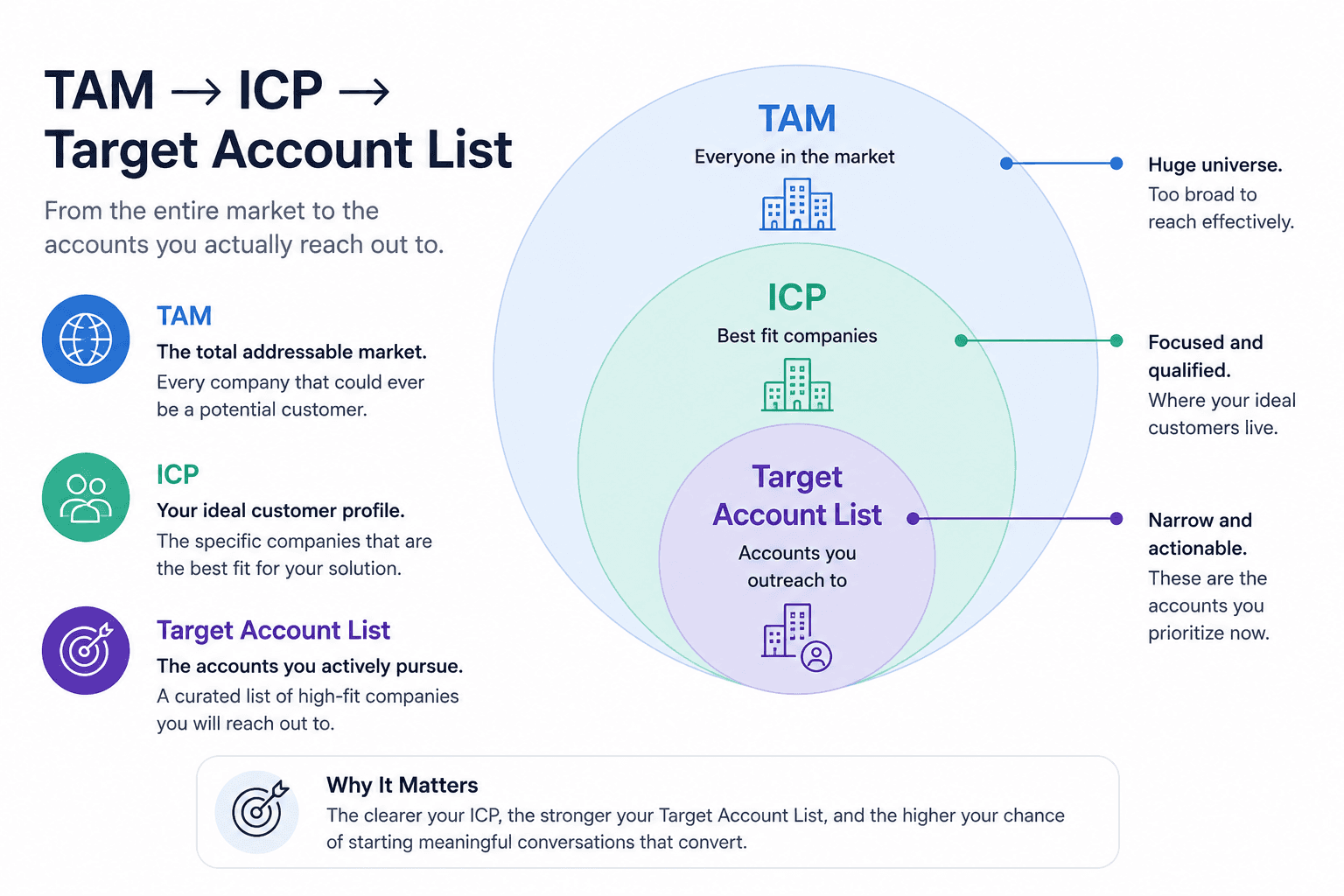
Category | TAM | ICP | Target Account List |
|---|---|---|---|
Full name | Total Addressable Market | Ideal Customer Profile | Target Account List |
What it is | The total possible market opportunity | The best-fit account profile inside that market | A specific list of named companies to pursue |
Main question | Who could buy this? | Who is most likely to get value and convert? | Which accounts are we engaging now? |
Scope | Broad | Narrow | Specific |
Typical size | Thousands to millions of accounts | A defined set of account traits | 50 to 5,000 accounts depending on motion |
Used for | Market sizing, investor story, strategic planning | Positioning, segmentation, campaign strategy | ABM, outbound, sales execution, territory planning |
Example | All B2B SaaS companies in North America | Series A to C SaaS companies with 50 to 500 employees and an outbound sales motion | 500 named SaaS companies matching that ICP, ranked by fit and signal strength |
The distinction that actually matters is use case. TAM sizes the opportunity. ICP creates focus. TAL executes. A massive TAM feels good in a board deck, but it doesn't tell your team which account to call on Tuesday. Salesforce defines TAM as the total potential revenue available if you captured 100% of a market. Useful for sizing, useless for targeting.
What Is TAM?
In short: TAM is the total revenue you could theoretically capture if every possible customer in your market bought from you.
You can express it two ways: account count (every company that could use your product) or revenue potential (total annual revenue available if you owned the whole category). If you sell compliance software to financial services, your TAM is every bank, fintech, insurance provider, and wealth manager that could theoretically buy your platform. Theoretically is the key word.
Why TAM matters. It answers leadership questions: is this market big enough to build a real business on, which market should we enter first, how big could this company become, does the category justify the investment. That's why TAM shows up in board decks and investor conversations. It shows the ceiling. It was never meant to show you who to email.
TAM vs SAM vs SOM
Term | Meaning | Question it answers |
|---|---|---|
TAM | Total Addressable Market | How big is the total opportunity? |
SAM | Serviceable Available Market | How much of that market can we realistically serve? |
SOM | Serviceable Obtainable Market | How much can we reasonably capture? |
TAM shows ambition. SAM and SOM make it more grounded. But none of these three move a GTM team into revenue execution. That's what ICP and TAL are for.
How to calculate TAM
Top-down TAM starts with an external market-size estimate and narrows it to your category. Example: the global HR software market is worth a certain amount, your product only serves onboarding, so you estimate the onboarding slice. Good for a slide, too abstract to run a campaign against.
Bottom-up TAM starts with the number of realistic accounts and multiplies by your average contract value:
Number of potential accounts × average annual contract value = TAM
Example: 20,000 potential accounts × $12,000 average ACV = $240 million TAM.
For outbound, bottom-up TAM wins every time, because it connects market size to accounts your team can actually find, enrich, and prioritize. A number on a slide doesn't book a meeting. A list of real companies does.
Common TAM mistakes
The biggest one: treating a theoretical market like a target audience. A founder tells me "our TAM is every SaaS company," and at a high level, sure. But that sentence has never booked a meeting. Every SaaS company doesn't share the same pain, budget, buying process, or urgency.
Other mistakes I see constantly:
Using TAM to justify emailing everyone
Confusing market size with actual demand
Ignoring geographic, regulatory, or operational constraints
Calculating TAM once in year one and never touching it again
Building a sending list straight from TAM with no ICP filter in between
TAM tells you the size of the opportunity. It does not decide who gets an email. That's the ICP's job.
What Is an Ideal Customer Profile?
In short: Your ICP defines the type of company most likely to feel your product's pain, have the budget to fix it, convert quickly, and stick around long enough to be worth acquiring.
Your ICP is not "everyone who could buy." It's the narrower slice where your offer has the best odds of turning into real, retained revenue. Gravity Global describes ICP as the quantitative and qualitative traits used to identify best-fit accounts inside a target market. That framing matters because "best fit" and "biggest market" are usually different lists. Clearbit makes the same point about sequencing: your ICP belongs at the front of your go-to-market strategy, not bolted on after the campaign is already live.
ICP attributes
Attribute type | Examples |
|---|---|
Firmographics | Industry, company size, revenue, location, growth stage |
Technographics | CRM, marketing automation, data tools, cloud platforms, ecommerce stack |
Behavioral signals | Hiring, funding, expansion, new leadership, product launch, category research |
Operational fit | Sales team size, GTM maturity, outbound readiness, existing process |
Economic fit | Budget, ACV potential, payback period, retention potential |
Pain fit | Specific problem, urgency, cost of inaction, internal pressure |
Weak ICP: B2B SaaS companies.
Better ICP: Series A to C B2B SaaS companies in North America with 50 to 500 employees, an outbound sales motion, a VP of Sales or Head of Growth, and pressure to grow qualified pipeline without adding SDR headcount.
The second version is useful because it forces tradeoffs. If your ICP doesn't exclude companies, it isn't an ICP. It's a wish list.
For a deeper walkthrough, see our guide to defining an Ideal Customer Profile.
ICP vs buyer persona
ICP | Buyer persona |
|---|---|
Account level | Person level |
Defines the company that should buy | Defines the individual involved in buying |
Uses firmographics, technographics, signals, fit criteria | Uses role, goals, objections, decision power |
Example: Series B SaaS company with 100 employees | Example: VP of Sales trying to hit pipeline targets |
Get the ICP right before you decide which person inside that account to contact. Persona work on the wrong company is wasted effort.
How do you know if your ICP is wrong?
A bad ICP doesn't usually look like zero replies. It looks like low-quality interest: replies from companies that are curious but can't buy, meetings with people who like the idea but have no budget, strong engagement and weak pipeline.
That's not a copywriting problem. That's an ICP problem.
"A high reply rate with no pipeline behind it isn't a win. It's a warning sign your ICP is off."
Jacob Bowman, Founder & CEO, OutboundLeads
We've run this stack across pre-revenue startups and companies that later hit nine figures in ARR, and this pattern repeats constantly: teams rewrite the email five times before anyone questions whether they're emailing the right company. Reply rate alone never tells the full story. Interested rate, conversion quality, and downstream revenue do.
Practical test: if your campaign gets replies but those replies don't turn into qualified opportunities, don't touch the copy yet. Recheck the ICP first.
What Is a Target Account List?
In short: A Target Account List (TAL) is the specific, named list of companies your sales and marketing team have chosen to pursue right now.
If TAM is the market and ICP is the filter, the TAL is the action plan. It turns strategy into names. It's the same account-based principle LinkedIn describes: concentrate effort on a defined set of high-value accounts instead of spreading it across a broad audience.
TAM: All B2B SaaS companies in North America
ICP: Series A to C SaaS companies, 50 to 500 employees, outbound sales motion
TAL: 750 named companies matching that ICP, ranked by fit, signal strength, and sales priority
What a Target Account List includes
A basic TAL has company name, website, industry, employee count, revenue range, location, LinkedIn URL, relevant decision-makers, ICP fit score, buying signals, priority tier, assigned owner, and campaign status. A stronger one goes further. It documents why each account is worth pursuing and what angle should open the conversation.
Here's what that looks like when it's built off real signal, using three campaigns we've run at OutboundLeads:
Account | ICP fit | Signal | Priority | Message angle |
|---|---|---|---|---|
Hendon (M&A advisory) | High | Had spent months on an AI SDR tool with zero booked calls | Tier 1 | Automate what the last tool couldn't: real meetings with real acquirers |
Baerskin Tactical (ecommerce) | High | Spending thousands monthly on Google Ads that never reached B2B buyers | Tier 1 | Reach the wholesale buyer directly instead of hoping they click an ad |
Unboxx Gifting (corporate gifting) | High | Referral pipeline had dried up with no backup channel | Tier 1 | When referrals dry up, you need a second engine, not a hope |
The results speak for themselves: Hendon booked calls with over 5% of their entire TAM and fully automated the lead handoff. Baerskin cut cost per lead by 72% and generated 4.8x more leads per month. Unboxx booked meetings with Apple and other Fortune 500 companies and generated over $500K in new revenue in the first six months. None of that happens from a list pulled off "all ecommerce brands." It happens from a TAL built on real signal and a real message angle.
How many accounts should be on a Target Account List?
There's no universal number. It depends on your ACV, sales capacity, market size, and motion.
Motion | Typical TAL size | Best for |
|---|---|---|
1:1 ABM | 10 to 50 accounts | Enterprise, high ACV, deep personalization |
1:few ABM | 50 to 500 accounts | Segmented campaigns by industry, signal, or pain |
Outbound campaign | 500 to 5,000 accounts | Scaled cold email or multi-channel prospecting |
Market test | 100 to 500 accounts | Testing ICP, offer, messaging, or a new segment |
For most B2B outbound teams, list size matters less than list quality. A tight list of 500 high-fit accounts will outperform 10,000 vague leads pulled from broad filters, every time. We'd rather run a client at 500 accounts with a 30%+ positive reply rate than 10,000 with a 1% reply rate that goes nowhere.
For a deeper tactical breakdown, see our guide on how to build a B2B lead list that converts.
How TAM, ICP, and TAL Work Together
Think of it as a narrowing system: TAM → ICP → buying signals → Target Account List → outreach → qualified pipeline.
Layer | Question | Output |
|---|---|---|
TAM | What is the full opportunity? | Market universe |
ICP | Which accounts are the best fit? | Account criteria |
Buying signals | Which accounts have a reason to act now? | Prioritization logic |
TAL | Which named accounts should we pursue? | Campaign-ready account list |
Outreach | What message should each segment receive? | Email, LinkedIn, calling, or ABM plays |
Real example: Hendon, M&A advisory. Their TAM was every M&A advisory firm that could use outbound-driven deal sourcing: broad. Their ICP narrowed that to mid-market firms with a defined outbound motion and an unmet need for consistent deal flow. The buying signal: they'd already burned months on an AI SDR tool and had nothing booked. Their TAL was the named list of firms matching that profile, scored and prioritized. The outreach was built around the exact gap that tool left open. The result: booked calls with over 5% of their entire TAM, and a fully automated handoff so their team stayed focused on closing instead of chasing.
That's the whole system working in sequence. Skip a layer and the chain breaks, usually at the outreach stage, where a team ends up messaging accounts that were never going to convert in the first place.
Why Most Outbound Campaigns Fail Before the First Email
Most outbound teams don't fail because they forgot to personalize a first line. They fail because the target account strategy was weak before anyone opened a sequencer.
Mistake 1: Confusing TAM with ICP
A large TAM feels exciting. It also makes outbound lazy. If your TAM is "all ecommerce brands," you can justify emailing almost anyone, and that's exactly the problem. Your ICP should force tradeoffs. If it doesn't exclude companies, it isn't doing its job.
Mistake 2: Building the List Before Defining the ICP
This is the most common error we see when a new client comes to us after being burned elsewhere. The previous team opened Apollo, Clay, or Sales Navigator, pulled titles and industries, and tried to reverse-engineer a strategy from a list that already existed. That order is backwards. Define the ICP first. Build the list second. Launch third. We cover the sequencing behind this in What Is a Go-To-Market Strategy?
Mistake 3: Treating Every ICP Account Equally
Two companies can match your ICP on paper and still deserve completely different attention. One might match your firmographic filters with zero urgency. The other might match the same filters with a fresh trigger: new CRO, new funding, active hiring. The second one gets contacted first. This is where buying signals earn their keep, a topic we go deeper on in Signal-Based Outbound vs Cold Volume Outreach.
Mistake 4: Measuring List Quality by Reply Rate Alone
A list can produce plenty of replies and still fail the business. If those replies come from companies with no budget, no authority, and no real pain, you don't have pipeline. You have noise. We track reply rate, positive reply rate, meeting-booked rate, qualified opportunity rate, pipeline created, and revenue by segment.
"Reply rate is the metric that feels good. Revenue by segment is the metric that pays payroll."
Jacob Bowman, Founder & CEO, OutboundLeads
Mistake 5: Never Refreshing the Target Account List
A TAL isn't a spreadsheet you build once. Companies grow, buyers leave, funding changes, hiring slows, tech stacks shift. A list that was accurate three months ago can be stale today. Aimerce, one of our SaaS clients, has had 17 straight months of consistent lead flow, and that doesn't happen from a static list. It happens from treating the TAL as a living asset: enriched, re-scored, and pruned on a rolling basis.
How to Build a Target Account List That Converts
Here's the sequence we actually run with clients.
Step 1: Define the Market
Document industries, company sizes, regions, business models, use cases, and category alternatives. This is your TAM layer, deliberately broad.
Step 2: Analyze Your Best Customers
Look at closed-won deals, fastest sales cycles, highest-retention accounts, and the ones with clear pain before they ever talked to you. Don't just ask who bought. Ask who became a good customer. The two lists are rarely identical.
Step 3: Define the ICP
Turn those patterns into criteria: industry, company size, revenue range, growth stage, tech stack, team structure, operational pain, buying trigger, and disqualifiers. The disqualifiers matter as much as the qualifiers. An ICP that only says who to include will drift within a quarter.
Step 4: Add Buying Signals
ICP tells you fit. Signals tell you timing. Funding announcements, new executive hires, hiring for sales or RevOps roles, product launches, geographic expansion, new compliance requirements, competitor displacement. Intent data suggests interest. A buying signal means something specific actually changed.
Step 5: Pull the Initial Account Universe
We use Clay, StoreLeads (for ecommerce), Crunchbase, and RB2B for website visitor identification, depending on the market. The tool matters less than whether it's pulling against a real ICP instead of a vague vertical.
Step 6: Enrich and Clean the Data
Domain, employee count, industry, location, tech stack, funding, hiring activity, leadership team, relevant contacts, email validity. This is the unglamorous step that protects deliverability and makes the rest of the process trustworthy. Skip it and you can't tell whether poor performance came from targeting, copy, or a bounced-out sending domain.
Step 7: Score Accounts
Not every account on the list deserves the same priority. Here's the actual weighting we use as a starting point with clients:
Score category | Weight | Example |
|---|---|---|
ICP fit | 40% | Industry, size, region, team structure |
Buying signal | 30% | Funding, hiring, new executive, expansion |
Revenue potential | 20% | Estimated ACV or expansion value |
Strategic fit | 10% | Brand value, category relevance, case study potential |
DemandScience's own research on account scoring reaches a similar conclusion: pairing ICP fit with buying-window readiness matters more than how elaborate the scoring formula is.
Step 8: Segment the List
Don't send one message to the whole TAL. Segment by industry, size, pain point, signal, persona, GTM maturity, or offer fit. Segmentation is where the messaging actually gets specific enough to land.
Step 9: Test Before Scaling
Never take a new TAL straight to full volume. Run a smaller batch, track bounce rate, reply rate, interested rate, meeting-booked rate, objection patterns, and pipeline created. If the test shows fit, scale it. If not, diagnose before you send more. Don't just send harder.
Tools We Use to Build Better Target Account Lists
Tools help. They don't replace strategy. This is the stack we run internally and with clients:
Tool category | Purpose | Examples |
|---|---|---|
Sales intelligence | Find companies and contacts | |
Data enrichment | Add firmographic, contact, and company data | |
Ecommerce-specific data | B2B lead gen for ecommerce brands | |
Website visitor ID | Deanonymize and qualify site traffic | |
Email infrastructure | Deliverability, warm-up, validation | |
Sequencing | Run outbound campaigns | |
Automation | Connect workflows, refresh data | |
CRM | Track accounts, opportunities, revenue |
We use Clay over the bigger legacy databases because it lets us build and refresh a TAL programmatically instead of manually re-pulling a static export every quarter. The tool stack should match how often your TAL actually needs to move, and for outbound, that's constantly.
Do You Need TAM, ICP, or a Target Account List?
If you are asking... | You need... |
|---|---|
How big is our opportunity? | TAM |
Which market should we focus on first? | ICP |
Which accounts should sales contact this month? | Target Account List |
Which accounts should get the most attention? | Target Account List with scoring |
Why are we getting replies but not pipeline? | ICP review |
Why are we sending more but booking fewer meetings? | TAL quality and signal review |
Frequently Asked Questions
What is the difference between TAM and ICP?
TAM is the total market opportunity for your product. ICP is the specific type of company inside that market most likely to become a successful, retained customer. TAM is broad. ICP is focused.
What is the difference between ICP and Target Account List?
An ICP is a definition. A TAL is the list of specific companies that match that definition. Your ICP might say "Series B SaaS companies with 100 to 500 employees." Your TAL names the exact companies that fit it.
What comes first, TAM or ICP?
TAM first, for market sizing. ICP next, for GTM focus. The Target Account List comes after the ICP, once you're ready to select named accounts for execution.
Is an ICP the same as a buyer persona?
No. ICP defines the ideal company. Buyer persona defines the ideal person inside that company. ICP might be mid-market SaaS companies. The persona might be the VP of Sales trying to hit a pipeline number.
How many companies should be on a Target Account List?
Depends on the motion. High-ACV ABM might run 25 to 100 accounts. Broader outbound might run 1,000 to 5,000. Size the list for quality first, volume second.
How often should you update a Target Account List?
At least monthly for active outbound. High-velocity campaigns targeting fresh signals (hiring, funding, leadership changes) should be refreshed weekly.
Can one company have multiple ICPs?
Yes, if it sells different products, serves different markets, or has distinct use cases. Each ICP needs its own messaging, account selection logic, and campaign strategy.
Can AI build a Target Account List?
AI can support research, enrichment, scoring, and filtering. We use it constantly in our own process. But it shouldn't be the only judge. The strongest lists combine AI-assisted research with human strategy, real customer evidence, and campaign feedback.
How do you know if your ICP is too broad?
Your messaging feels generic, your team can't explain why a specific account was selected, replies don't convert into pipeline, or your sales team spends most of its time disqualifying leads instead of closing them.
What's a good Target Account List for outbound?
Named companies that match your ICP, show a relevant buying signal, have reachable decision-makers, and can be segmented into campaigns with a clear message angle for each segment.
Should startups define TAM before outbound?
Yes. It shows you the ceiling. But don't stop there. ICP and TAL are what decide where your limited GTM budget actually goes.
What's the biggest mistake companies make with TAM, ICP, and TAL?
Using TAM as a lead list. TAM is not a campaign audience. It's the size of the market. Outbound should be built from ICP criteria and target account prioritization, not from the broadest possible filter.
Final Thoughts
TAM, ICP, and Target Account List aren't interchangeable, and treating them like synonyms is how outbound budgets get burned. TAM gives you the size of the opportunity. ICP gives you the best-fit customer profile. TAL gives your team the specific accounts to contact.
When these three layers are clear, outbound becomes something you can actually diagnose instead of guess at. Market's wrong? Revisit the TAM assumptions. Customer fit is off? Fix the ICP. Campaign is reaching weak accounts? Fix the TAL.
We built OutboundLeads around this exact sequence because it's the difference between an outbound motion that produces pipeline and one that produces excuses. The best outbound teams don't win by sending to everyone. They win by knowing exactly who deserves the message, why that account matters, and why now is the right time to reach out.
Ready to build a Target Account List that actually creates pipeline?
OutboundLeads helps B2B companies define the right ICP, build high-quality target account lists, and launch outbound campaigns built around qualified pipeline.