
Jacob Bowman

A trigger-based prospecting system monitors relevant changes across your target accounts, qualifies each event against your ICP and your offer, finds the right buyer, and launches outreach on a rule instead of a calendar. A trigger only earns a message when it gives a specific prospect a specific reason to care about a specific offer right now.
Teams that buy a signal or intent tool often end up with the same problem: hundreds of alerts a week and no workflow that turns any of them into a qualified conversation. We treat a trigger the way we treat any other unit of pipeline at OutboundLeads: something that has to be detected, qualified, enriched, scored, routed, and measured before it earns a permanent place in a campaign. Across 3,000+ campaigns for 50+ B2B clients, the shift from watching signals to operationalizing them is what separates a dashboard nobody opens from a system where the repetitive steps run on their own and a person steps in only where judgment is required.
We already covered what buying signals are and why timing beats volume in our guide to signal-based outbound, and the exact difference between intent data and a buying signal in a separate comparison. This guide picks up where those leave off. It is not another list of trigger examples. It is the operating system that turns a chosen trigger into a qualified meeting, built from the same infrastructure and workflows we run for clients today.
What Is Trigger-Based Prospecting?
Trigger-based prospecting is the practice of building a repeatable workflow around one or more specific, dated business events, so that when the event fires, an account is automatically qualified, enriched, and routed into outreach designed around that event. Where signal-based outbound is the broader targeting philosophy, trigger-based prospecting is the machinery: the rules, the automation, and the qualification steps that decide what happens the moment a trigger fires.
What Is a Sales Trigger Event?
A sales trigger event is an observable, dated change at a company that may create a timely reason to reach out. Crunchbase describes it as an occurrence that opens a sales opportunity, listing funding rounds, leadership hires, layoffs, restructuring, and expansion among the most common examples. A trigger event is not the same as ongoing behavior like a research pattern. It is something specific that happened on a specific date: a company raised a Series B on a Tuesday, hired a VP of Sales the following month, or posted twelve open SDR roles in one week.
Trigger Events, Buying Signals, and Trigger Rules
These three terms get used interchangeably, and that is where prospecting systems break down. A trigger event is something that changed. A buying signal is the broader category, any observable event or behavior that suggests a change in buying readiness, which includes trigger events alongside engagement and research behavior. A trigger rule is the condition your system uses to decide what happens next: which trigger, combined with which fit criteria, routes into which campaign. We go deeper on the signal and intent side of this distinction in our intent data versus buying signals guide. This article focuses on the third term: the rule, and the system behind it.
Trigger-Based Prospecting vs. Signal-Based Outbound
Signal-based outbound is the methodology: use real events to decide who gets contacted, when, and with what message, instead of blasting a static list. Trigger-based prospecting is the operational layer underneath it, specifically for discrete, dated business events rather than the full range of signals (which also includes ongoing engagement and intent data). If signal-based outbound answers which signals matter, this guide answers how you turn one chosen trigger into a functioning, always-on pipeline motion.
Why a Signal Dashboard Is Not a Prospecting System
Buying a tool that flags funding rounds, job changes, or technology adoption does not create pipeline by itself. It creates a feed. The gap between a feed and a system is qualification, enrichment, routing, and a defined response time, and that gap is where trigger programs stall.
The failure pattern looks the same across industries: a RevOps lead sets up alerts for ten different trigger types, the alerts land in a shared inbox or a Slack channel, and within a month nobody is checking them anymore. The team did the easy part (detection) and skipped the hard part (a rule that automatically decides what to do next). A trigger that requires a human to notice it, research the account, find a contact, and manually load a sequence has already lost most of its value by the time outreach goes out.
What Makes a Sales Trigger Worth Acting On?
This is the single most important filter in the whole system, and it is the one most programs skip.
I do not evaluate a trigger against a checklist of signal types. I evaluate every campaign against four questions before a single lead gets loaded:
"Who are we targeting? Why are we targeting them? Why is it important to them, and why should they respond? If you can answer those four questions, then you will reverse engineer how you are going to build the campaign in the first place." Jacob Bowman, Founder of OutboundLeads
The Trigger Must Connect to Your Offer
A funding round is not automatically relevant to every vendor watching for it. Its value depends on what the company is likely to do with that capital, and whether that action creates a problem your offer solves. A payroll software company and a commercial real estate broker should not treat the same funding announcement as an equally strong trigger.
The Account Must Still Fit the ICP
Fit determines who could buy. The trigger only helps you prioritize who might have a reason to buy now. A perfectly timed event at a company outside your ICP is still not worth a message. This is also why firmographic fit on its own is not enough, and why it should never be dropped just because a trigger looks exciting.
The Trigger Must Suggest a Specific Problem
There is a difference between an observable fact and its commercial implication, and most trigger programs stop at the fact. Consider a senior living operator whose regional managers are posting publicly about not being able to hire enough caregivers. The observable fact is a staffing complaint. The implication, for a vendor selling workforce or scheduling automation, is a live, specific, budget-relevant problem. For a vendor selling something unrelated to labor, the same post is noise. This is the reasoning behind pairing multiple AI models against a lead list before a campaign launches, checking public sources for anything, a complaint, a hiring pattern, a forum post, that ties back to the specific problem the campaign is built to solve, rather than triggering on the event alone.
The Signal Must Be Detectable and Fresh
A trigger you cannot verify with real data, or one you can only catch weeks after it happened, behaves like cold outbound with an expensive dashboard attached to it. Source reliability, timestamp availability, and detection-to-outreach delay all matter more than how interesting the trigger sounds on a slide.
Which B2B Sales Triggers Should You Track?
Do not try to track everything Crunchbase, LinkedIn, and a job board can throw at you. Pick the categories that map to the problem your offer solves, and treat the rest as noise. Here is how we group them for client accounts, with a starting point for how long each stays useful. Treat the freshness column as a working guideline to calibrate against your own closed-deal data, not a fixed rule, since the right window depends heavily on your sales cycle and your offer.
Category | Example events | Freshness guideline (starting point) |
|---|---|---|
Company change | Funding round, acquisition, restructuring, market expansion | Days to a few weeks |
People & leadership | New executive in a relevant function, champion changes jobs | Two to six weeks |
Hiring & growth | SDR hiring spike, new department, cluster of relevant job posts | Two to eight weeks |
Technographic | New platform adopted, competitor tool removed, contract renewal window | Weeks to months |
Behavioral & intent | Trial signup, pricing page visit, content engagement | Hours to a few days |
Relationship & engagement | LinkedIn engagement, past conversation resurfacing, referral | Days to weeks |
Negative & suppression | Recent customer, open opportunity, recent hard no, layoffs | Suppress until re-qualified |
These ranges are a starting point, not a benchmark to defend in a report. Pull your own closed-won timelines and adjust every window up or down from there.
That last row matters as much as the other six. A system that never suppresses is not a trigger system, it is just a faster way to send the wrong email to the wrong account at the wrong time.
How Do You Choose the Right Triggers for Your Offer?
Start with the problem your offer solves, not with the list of triggers a vendor sells you. Ask what has to be changing at a company for that problem to become urgent, and what typically happens right before a company like that starts looking for a solution.
Then look backward. Pull your last fifteen to twenty closed-won and closed-lost deals and check what changed at the account before the first real conversation. This is exactly how we approached one M&A advisory client. Their pipeline had been running on a single generic AI SDR tool against one flat account list, with no segmentation by anything other than firmographic fit, and it produced zero booked calls. We rebuilt the same account universe around trigger cohorts instead: recent business changes, prior engagement history, and the specific pain points that showed up in past conversations, so the same target account list generated multiple distinct campaigns instead of one undifferentiated blast. The result was booked calls across more than 5% of their entire TAM, with the lead handoff fully automated so the team stayed focused on closing.
Once you know which events precede your best deals, prioritize three to five for your first test. Trying to launch on twenty trigger types at once is how teams end up back at the dashboard-nobody-opens problem. If you have not yet built a properly scored account universe to layer these triggers onto, start with building a target account list that converts, and if you are still untangling TAM, ICP, and your target account list as concepts, that comparison is covered in a separate guide.
The OutboundLeads Trigger-Based Prospecting Framework
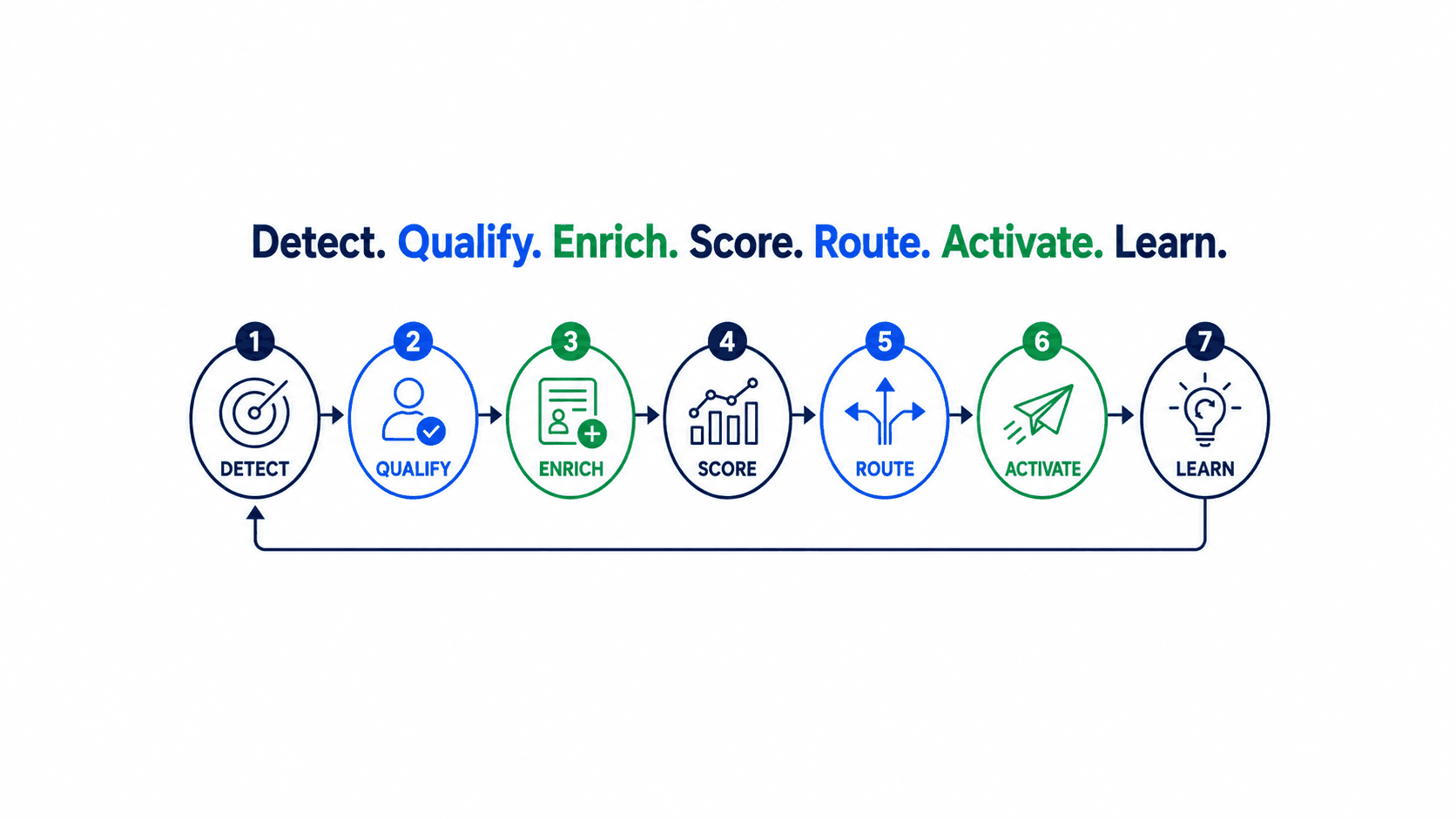
This is the system underneath every trigger-based campaign we run. It extends the five-step model from our signal-based outbound framework into the specific mechanics of a discrete, dated trigger event.
Detect: Capture the Trigger
Every trigger needs a source, a monitoring frequency, a timestamp, an account identifier, and a confidence level. Some of that comes from structured data (Crunchbase for funding, LinkedIn for job changes), and some of it has to be pieced together from unstructured mentions across the web. For less structured triggers, like a public complaint or a hiring difficulty post, we run the account list through multiple large language models at once (Gemini, Perplexity, ChatGPT, and others) against the specific campaign thesis, checking sources from YouTube to Reddit to LinkedIn posts to blog articles for anything a named account has said that ties back to the problem the campaign solves. The output is not a generic alert. It is a lead flagged as relevant to that specific campaign idea, not just relevant in general.
Qualify: Confirm Fit and Relevance
Every detected trigger gets checked against firmographic fit, commercial relevance, freshness, existing CRM relationship, and suppression rules before it goes anywhere near enrichment. In one cybersecurity engagement, the useful trigger was not "uses security software," it was a specific technographic combination: adoption of a named EDR platform plus an established channel-partner relationship with a named SIEM vendor. That combination separated MSSPs with an actual reason to evaluate a new offering from a generic list of managed security providers that happened to share an industry code.
Enrich: Find the Account Context and Buyer
An account-level trigger still needs a person. We run enrichment through BetterContact for waterfall verification and Prospeo for work email discovery, layering in role, tenure, and prior interaction history so the record that reaches a rep is a real, reachable decision-maker rather than a generic title match.
Score: Rank the Opportunity
Keep scoring simple enough that a rep trusts it on sight. We rank across ICP fit, trigger strength, freshness, problem relevance, buyer authority, and reachability. The goal of the score is a routing decision, not a leaderboard nobody checks.
Route: Select the Campaign and Owner
Every trigger cohort should land in its own campaign with its own messaging hypothesis, not get folded into a general sequence. For one SaaS client, this meant plugging the qualified, scored lead directly into their existing RevOps environment with automated round-robin call booking, so a qualified trigger never sat in a queue waiting for someone to manually assign it. That single change was part of a broader shift that delivered seven times the results of their previous in-house campaigns.
Activate: Launch While the Context Is Fresh
Speed of activation is where trigger programs win or lose more than any amount of clever targeting. One SaaS client had people signing up for a free trial and disappearing, with no follow-up system in place at all. We built a personalized follow-up flow triggered directly off the signup event itself, using one-to-one copy instead of a template. Booked calls increased 700%, and free-to-paid conversions jumped more than 20%. The trigger did not change. The speed and specificity of the response did.
Learn: Feed Outcomes Back Into the System
Every trigger cohort should be measured on its own, not blended into a single campaign average. Track positive replies, meetings, and pipeline by trigger source, then feed that back into which triggers you keep testing and which ones you retire. Consistency compounds here: one client ran seventeen straight months of steady lead flow, launching new offers into market along the way, because the system kept refreshing which triggers and offers were paired together rather than running the same static list on repeat.
What Does a Trigger-Based Workflow Look Like in Practice?
Take a common starting point: a company exports a list of SaaS companies with 50 to 500 employees, finds every Head of Sales, and sends one generic growth-focused sequence to all of them. When results come in soft, there is no way to tell whether the problem was fit, timing, offer, or message, because everything ran as a single undifferentiated block.
Now run the same audience through a trigger-based version. The ICP stays the same: B2B SaaS companies inside the target size range. The trigger is a cluster of SDR hiring activity, three or more relevant roles posted inside a rolling 30-day window. Validation checks geography, sales motion, and whether an active opportunity already exists. Enrichment surfaces the VP of Sales, the RevOps lead, or the Head of Growth, whoever owns the ramp for those new hires. The commercial implication is specific: a company scaling its SDR team usually needs outbound infrastructure, data coverage, and process consistency faster than it can build internally. The campaign is written around that exact pressure, launched inside the freshness window for a hiring trigger, and measured separately from every other trigger cohort running at the same time.
How Should You Automate Trigger-Based Prospecting?
Automate the mechanical steps and keep humans on the judgment calls. Signal capture, timestamping, ICP filtering, enrichment, deduplication, CRM checks, and routing should run without a person touching each record. Ambiguous trigger interpretation, high-value account research, sensitive events like layoffs, and the actual sales conversation still need a human. This is the same architecture we describe in our GTM engineering guide: data, enrichment, qualification, and outreach wired into one pipeline instead of scattered across ten dashboards.
Preventing duplicate or stale outreach matters as much as detection. Set an expiration on every trigger type, check new leads against active CRM records before they enter a sequence, and build a campaign-conflict check so the same account cannot get pulled into two competing trigger campaigns at once.
For the minimum viable stack, you need a signal aggregation layer that pulls funding, hiring, and technographic data into one place, Clay, alongside raw sources like Crunchbase and LinkedIn Sales Navigator, an enrichment and verification layer (BetterContact, Prospeo), an automation layer to move records between systems without manual copying (n8n, Make), and a sequencing layer built on isolated, warmed infrastructure (Instantly, EmailBison). HubSpot's own workflow documentation is a useful reference if you are building trigger automation inside a CRM you already run, since event-based enrollment triggers there work on the same underlying logic: something happens, a record enters a defined workflow automatically.
How Do You Write Outreach Around a Sales Trigger?
Lead with the implication of the trigger, not the announcement itself. "Congratulations on your funding round" tells the reader nothing about why you are writing. A stronger opening states the pressure that event typically creates: growing a sales team after a raise usually creates pipeline pressure before the new hires are fully productive. That is a reason to respond. A congratulations is not.
Match the offer and the proof point to the specific trigger. A funding-based opener, a hiring-based opener, and a technology-change opener should not point to the same case study or the same next step. Test that assumption before you scale it. In one M&A-focused campaign, four message variants ran in an even split. Three, built around different angles, produced nearly all of the positive replies. The fourth, a technical variant built around merger and acquisition terminology, produced next to none despite getting an equal share of send volume. Turning that variant off and reallocating its share to the three working angles lifted total reply volume immediately, without touching targeting or the winning copy. The lesson was not that the trigger itself was wrong. It was that the message built around it needed the same testing discipline as every other angle.
How Do You Measure Whether a Trigger-Based Campaign Is Working?
Measure the system in stages and never blend trigger cohorts into one number. Track trigger volume, valid-trigger rate, ICP qualification rate, verified-contact rate, signal-to-send time, positive reply rate, meeting rate, and pipeline by trigger source.
Where the drop happens | What it usually means |
|---|---|
Many events detected, few pass qualification | Trigger definition is too broad |
Qualified accounts, few reachable contacts | Enrichment gap or the wrong buyer persona |
Delivered messages, weak reply rate | Weak implication, offer, or copy |
Positive replies, few booked meetings | Follow-up speed or CTA problem |
Meetings held, few move to SQL | Trigger or buyer quality issue |
SQLs created, little real pipeline | Commercial fit or sales-process issue |
Optimize for the trigger that consistently produces qualified opportunities, not the one that produces the biggest alert count.
Common Trigger-Based Prospecting Mistakes
Treating every company event as a buying signal, regardless of relevance to the offer
Choosing triggers because a tool happens to track them, not because closed deals show the pattern
Running the same message against every trigger type instead of writing to the specific implication
Dropping ICP fit the moment a trigger looks exciting
Letting a real trigger go stale because a human had to notice it first
Automating the full pipeline before validating the logic on a small, manually reviewed sample
Mixing every trigger source into one campaign average, which hides which ones work and which ones do not
Skipping suppression rules, so recent customers and open opportunities get contacted again
Should You Use Trigger-Based Prospecting Alongside Cold Outbound?
Yes, in almost every account we run. Triggers only surface accounts that take a visible, detectable action, and plenty of strong-fit buyers never do anything observable before they are ready to talk. A blended model uses trigger-based campaigns to catch the accounts showing real-time change, while structured, segmented cold outbound keeps building awareness across the rest of the ICP that never trips a single alert. Treating trigger-based prospecting as a full replacement for cold outbound just means you stop reaching everyone who fits but never shows up on a dashboard.
Build a Trigger System That Produces Pipeline
If you already have signal or intent tools running and no workflow connecting them to booked meetings, or a target account list with no way to tell which accounts deserve attention this week, that gap is exactly what a trigger-based system closes. OutboundLeads has generated $45M+ in pipeline across 3,000+ campaigns for 50+ B2B clients, building the detection, qualification, and activation workflows behind that pipeline end to end.
Book a free strategy call and we will map the triggers, data sources, and campaign logic that make sense for your offer and your market.
Frequently Asked Questions
What is trigger-based prospecting?
Trigger-based prospecting is a system that detects specific, dated business events at target accounts, qualifies each one against ICP fit and offer relevance, enriches the record with the right buyer, and routes it into outreach built around that event. It is the operational layer that turns a chosen trigger into a repeatable source of qualified meetings.
What is a sales trigger event?
A sales trigger event is an observable change at a specific company on a specific date, such as a funding round, an executive hire, a hiring spike, or a technology change, that may create a timely reason to reach out. It differs from ongoing research behavior in that it is a discrete, verifiable occurrence rather than a pattern of activity.
Is trigger-based prospecting the same as signal-based outbound?
They are closely related but not identical. Signal-based outbound is the broader methodology of using real events and behavior to decide who gets contacted and when. Trigger-based prospecting is the operational system built specifically around discrete, dated trigger events: the detection, qualification, and automation workflow that activates outreach the moment one fires.
How do you automate trigger-based prospecting?
Automate detection, ICP filtering, enrichment, deduplication, CRM checks, scoring, and routing using tools like Clay, n8n, BetterContact, and Prospeo, connected through webhooks so a qualified trigger reaches a sequencing platform without manual steps in between. Keep ambiguous interpretation, high-value account research, and the actual sales conversation with a human.
How quickly should you contact a prospect after a trigger event?
There is no universal rule, only a starting point to calibrate against your own closed-deal data. As a working guideline, a pricing-page visit or trial signup is often worth acting on the same day, a hiring spike or leadership change can often stay relevant for several weeks, and a funding announcement usually sits in between, with the strongest window in the first week before competing outreach floods the account. Treat these as guidelines to test, not benchmarks to defend.
How do you score sales triggers?
Score across ICP fit, trigger strength, freshness, how directly the trigger connects to a real problem, buyer authority, and reachability. Keep the model simple enough that a rep understands the score at a glance, since the purpose is a routing decision, not a leaderboard.
What tools can track B2B sales trigger events?
Crunchbase and LinkedIn Sales Navigator cover funding, leadership, and job-change triggers. Clay aggregates technographic, hiring, and funding data into one workflow. BetterContact and Prospeo handle contact enrichment and verification once a trigger qualifies an account. Automation platforms like n8n or Make move qualified triggers into your sequencing tool without manual handling.
Can trigger-based prospecting replace cold outbound entirely?
No. Triggers only surface accounts taking a visible, detectable action, and many strong-fit accounts never generate one. The strongest programs run both: trigger-based campaigns for accounts showing active change, and structured cold outbound to build awareness across the rest of the ICP at a controlled, segmented pace.
How do you measure whether a sales trigger is producing pipeline?
Track each trigger cohort separately across valid-trigger rate, contact match rate, positive reply rate, meeting rate, and pipeline generated. Diagnose failures at the specific stage where the drop happens rather than blending every trigger source into one campaign average, since the fix for a qualification problem looks nothing like the fix for a weak follow-up.