
Jacob Bowman

Signal-based outbound is a B2B prospecting method that uses buying signals, real events like funding rounds, hiring spikes, and website visits, to decide who to contact, when to reach out, and what to say. It replaces static list blasting with timed, relevant outreach to buyers who are showing purchase readiness.
We run this system every day at OutboundLeads. Our team sends 1.5M+ emails a month across 500+ domains, and the shift from volume-first campaigns to signal-led outbound has been the single biggest lever on reply quality we have seen. This guide covers the definition, the signals that matter, the exact framework we use for clients, and the results you should expect.
What Is Signal-Based Outbound?
Signal-based outbound is an approach to B2B sales where outreach is triggered by observable buying signals instead of a static contact list. A signal is any measurable event that suggests an account is more likely to buy right now: a funding round, a leadership change, a pricing page visit, or a public complaint about a competitor.
Traditional cold outbound works in the opposite direction. You build a list of everyone who fits your firmographic profile, load it into a sequencer, and contact all of them on the same schedule regardless of what is happening at those companies. Some people call the signal-led version signal-based selling or trigger-based outbound. The label matters less than the mechanic: the event decides the timing instead of the calendar.
The difference sounds subtle. In practice it changes everything downstream: your targeting, your copy, your infrastructure load, and your reply rates.
Why Is Signal-Based Outbound Replacing Cold Volume Outreach?
Three structural shifts pushed B2B teams toward signals. Together they explain why sending more emails stopped working as a strategy. We covered the full comparison in signal-based outbound vs cold volume outreach, so here is the short version.
The 95:5 Rule: Only 5% of Your Market Is Buying Right Now
Research from the Ehrenberg-Bass Institute, often cited as the 95:5 rule, shows that only about 5% of your market is actively in a buying window at any given time. Cold volume outbound treats all 100% the same. That means 95% of your sending budget, your domain reputation, and your SDR hours go to people who have no reason to respond this quarter. Signals exist to find the 5%. This is also why firmographic segmentation fails for B2B outbound on its own: industry and headcount tell you who fits, and say nothing about who is ready.
Inbox Saturation and Deliverability Limits Killed the Volume Game
B2B decision makers now receive over 100 cold emails a week. At the same time, Google and Microsoft tightened spam filtering, and complaint thresholds got stricter. High-volume generic sending damages sender reputation faster than it books meetings. Signal-based outbound sends fewer, better-timed emails, which protects the infrastructure layer. It is also why we self-host our sending infrastructure with a dedicated IP per client.
"On shared infrastructure, you could be doing everything right, but someone else on the same IP is doing something that damages its reputation. Your reply rates start tanking and you have no clue why. Everything we run is isolated. None of our clients share an IP."
Jacob Bowman, Founder of OutboundLeads
What Reply Rates Does Signal-Based Outreach Get?
The gap in the data is wide. According to the Instantly 2026 Cold Email Benchmark Report, the average cold email reply rate is 3.43%. Apollo's benchmark analysis puts healthy broad campaigns at 3% to 6%, with rates above 8% tied to tight segmentation and buying signals. Autobound's signal-based selling research found that outreach referencing specific trigger events reaches 15% to 25% reply rates, roughly five times the generic average.
Dimension | Cold Volume Outbound | Signal-Based Outbound |
|---|---|---|
Timing | Fixed cadence, same day for everyone | Triggered by a real event at the account |
Targeting | Static firmographic list | Accounts showing purchase readiness |
Personalization | First name and company name tokens | The signal itself is the opening line |
Reply rate benchmark | 3.43% average (Instantly, 2026) | 15% to 25% for signal-referenced outreach (Autobound, 2026) |
Infrastructure load | High volume, high deliverability risk | Lower volume, protected sender reputation |
Reply rate alone is a vanity metric, though. The number that matters is positive replies. Our internal baseline for a healthy campaign is one positive reply for every 300 people contacted, and a total reply rate above 1.5% before optimization. If yours is below that, start with fixing a reply rate stuck below 3% before adding signals on top of a broken system.
Which Buying Signals Matter Most in B2B Outbound?
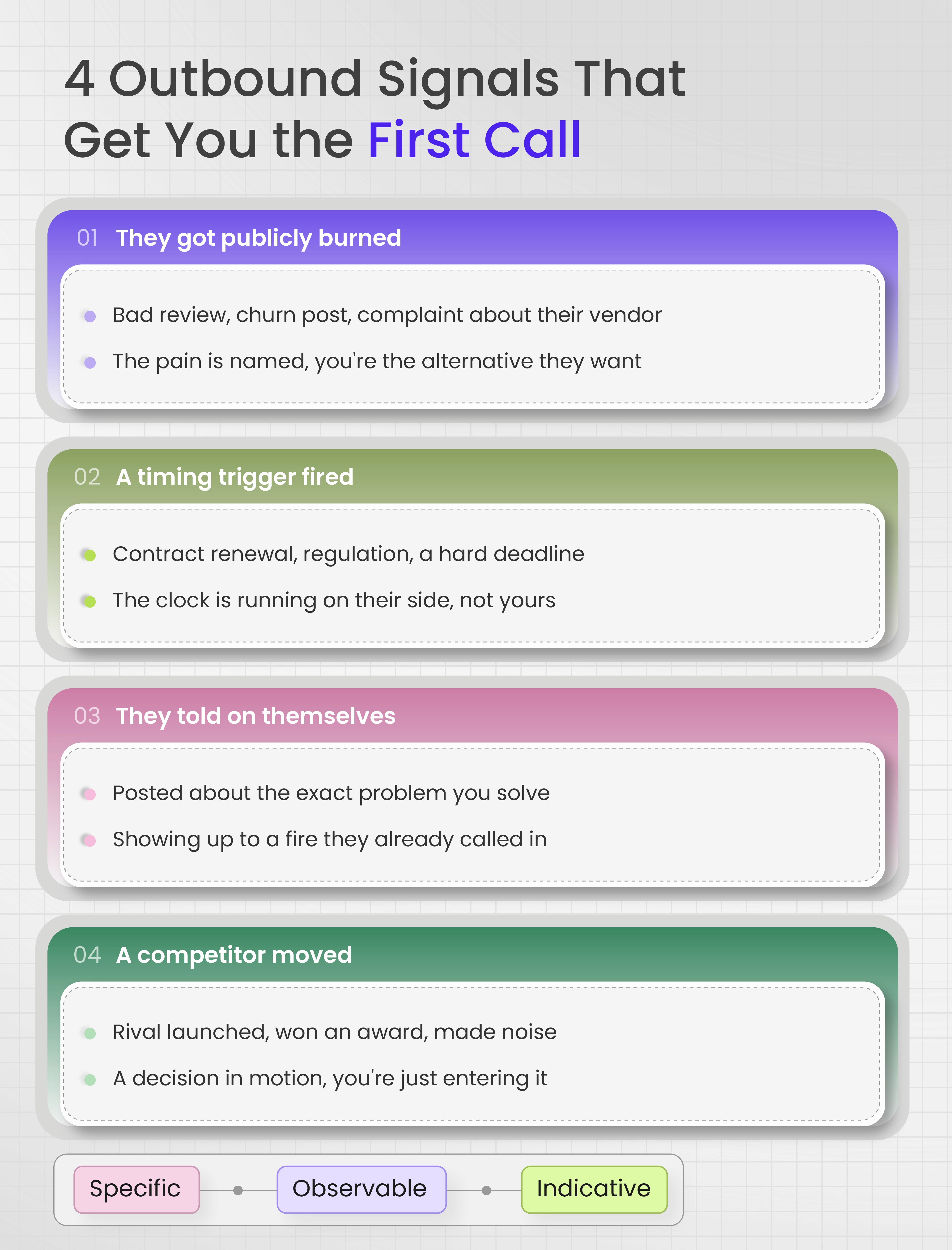
Not every signal deserves outreach. After 3,000+ campaigns, we group the signals that consistently produce first calls into three categories.
Intent and Engagement Signals
These are actions the buyer takes toward you or your category: repeat website visits, pricing page views, LinkedIn engagement on your content or a competitor's, content downloads, and G2 comparison activity. A prospect who posted about the exact problem you solve has told on themselves. Reaching out at that moment means showing up to a fire they already called in.
Timing and Trigger Signals
These are events that open a buying window whether or not the buyer has found you yet: funding rounds, new leadership hires, hiring spikes for roles your product supports, contract renewal dates, regulation deadlines, and expansion announcements. A new VP in their first 90 days is rebuilding the stack and has both budget and a mandate. The clock is already running on their side.
Competitive and Review Signals
These signals show a decision already in motion: bad reviews against a competitor, public churn posts, a rival launching a product or winning an award, or a company dropping a tool from their tech stack. When a prospect gets publicly burned by their vendor, the pain is named and you are the alternative they are looking for.
What Makes a Signal Worth Acting On?
We run every candidate signal through a three-part test. It must be specific: tied to a named account and a dated event. It must be observable: detectable with data on a repeatable basis rather than by gut feeling. It must be indicative: it correlates with deals you have closed before. If a signal fails any of the three, it is noise. The fastest way to build this filter is to analyze your last 20 closed-won deals and note which events preceded them. That analysis starts with defining your ideal customer profile properly.
What Is Signal Stacking?
Signal stacking is the practice of layering two or more independent signals before triggering outreach. One signal is context. Stacked signals are intent.
A single LinkedIn profile visit could mean a hundred things: recruiting, curiosity, a misclick. The same visit combined with a funding announcement and a relevant job posting is a different story. That account has money, is investing in the problem you solve, and someone there is looking at you. Teams that struggle with signal-based prospecting are almost always acting on single signals. Teams that win wait for two or three to align, then move fast.
The OutboundLeads Signal-Based Outbound Framework
This is the system we deploy for clients. It is the operational side of GTM engineering: data, enrichment, qualification, and outreach connected into one pipeline that runs continuously.
Step 1: Define Your ICP and Pick Two to Three Signals Worth Tracking
Do not start with 40 signal columns. Start with your ICP, then pick the two or three signals that showed up before your best closed deals. For one client that might be ad engagement plus decision-maker title. For another it is funding plus hiring velocity. Load those criteria into a scored account list. If you do not have one yet, here is how to build a target account list that holds up under this system.
Step 2: Route Every Signal Into One System
Signals are useless scattered across ten dashboards. We route everything into Clay: website visitor identification, CRM reports pushed by webhook, LinkedIn engagement, funding and hiring data. The goal is that every new signal lands in the same pipeline within minutes of firing, with no human copying rows between tools.
A real example from a current client engagement. Their paid ads generated thousands of people who clicked but never opted in for anything: no form fill, no demo request, nothing. That click is a signal, and it was sitting unused in their CRM. We built a webhook that pushes those contacts into a Clay table as they come in, filtered to clicks from the past 60 days so the signal is still warm. The table enriches each lead, an agent verifies they are a decision maker and that their work email matches their current employer, and qualified leads flow into an always-on campaign with copy written around the intent they already showed. The campaign never shuts off. New ad clickers feed in every day, and the client captures buyers who would otherwise have clicked once and disappeared.
Step 3: Qualify and Score Before Anything Sends
This step separates a signal system from a spam cannon. Every lead that enters the pipeline gets checked against the ICP: is this a decision maker, is the company in scope, is the contact data current, is the work email tied to their present employer. We run agent-based qualification on top of Clay enrichment because signals produce false positives, and one bad send to a mismatched contact costs more than ten skipped sends. Leads that fail qualification go back to the pool. No archetype, no reason, no send.
Step 4: Automate the First Touch, Let Humans Handle Warm Replies
The first touch is automated for one reason: speed. Signals decay in days, and a human SDR checking a queue every morning is too slow across time zones. The copy references the specific signal, the campaign fires within hours, and the SDR steps in only when a warm reply lands. That is where humans create value: in the conversations themselves. The sequence behind the first touch matters just as much, and we built our approach into a scalable follow-up system you can copy.
Step 5: Run Always-On Campaigns and Measure by Signal Source
Signal-based campaigns never really end. New signals feed in continuously, qualified leads enter automatically, and the campaign keeps rolling. Every lead carries a signal-source tag, so after a quarter you know exactly which signals produce meetings and which produce noise.
Measurement is where the compounding happens, because the campaign itself generates signals. One of our clients had a campaign with solid reply rates and interested prospects, but almost nobody booked. We tested subject lines, CTAs, and offer framing. Nothing moved. Then we pulled engagement by email position and found that the lead magnet in email two was generating nearly every positive reply, while the one in email one was producing opt-outs. We swapped them. Same audience, same copy, same offer. The result was fewer opt-outs on the first touch, more replies on email one than email two had ever produced, and a 600% increase in meetings booked. The fix was already inside the campaign data. It was just in the wrong order.
How Fast Do Buying Signals Decay?
A signal is perishable. A funding announcement is high value for about 72 hours, then every seller in the category has sent their congratulations email. A pricing page visit is hot the same day. A leadership change holds value for one to two weeks. Past roughly 7 days, acting on a signal is just cold outbound with fresh paint.
This is why detection without automated activation fails. If your workflow requires a human to notice the signal, research the account, write the email, and load the sequence, your average signal-to-send latency will be measured in days and the window will already be closed. Speed of activation decides where signal-based programs win or lose, far more than sophistication of detection.
What Tools Do You Need for Signal-Based Outbound?
You need four functions covered. These are the tools we run or recommend for each.
Signal Detection Tools
RB2B identifies the people visiting your website, your strongest first-party intent signal
LinkedIn Sales Navigator tracks job changes, engagement, and account activity
Clay monitors funding rounds, hiring activity, and technographic changes across your account list
Enrichment and Orchestration Tools
Clay is the layer that ties signals, ICP filtering, and personalization together, and here is how Clay and Apollo compare if you are choosing a data backbone
BetterContact runs waterfall enrichment so contact data gets verified across multiple providers before anything sends
Prospeo finds and verifies work emails at the contact level
Execution and Infrastructure Tools
Instantly or EmailBison for email sequencing, running on isolated, properly warmed infrastructure
Zapmail for the infrastructure itself: isolated domains, automated DNS, and mailbox setup at scale
EmailGuard for inbox placement testing and deliverability monitoring
Automation Tools
n8n or Make to move signals between systems through webhooks, with no manual steps between detection and send
Tool selection matters less than architecture. The full breakdown of what we run across client accounts is in our full B2B outbound tech stack guide.
What Are the Most Common Mistakes to Avoid?
Five mistakes derail most signal-based outbound programs. All of them are fixable with process, none with more volume.
Acting on a single signal. One event is a hypothesis. Stack at least two before sending.
Chasing the signals everyone sees. A trending funding round attracts fifty congratulations emails in a week. Quieter signals, like hiring velocity changes or review activity, face less competition and convert better.
Acting too slowly. A signal detected on Monday and actioned the following week is worthless. Measure your signal-to-send latency and cut it under 24 hours where possible.
Hoarding signals without a trigger rule. Data collection feels productive. Without a defined threshold that fires outreach, you have built an expensive spreadsheet.
Letting signals go stale. A company that froze hiring last week should not receive your growth pitch this week. Refresh signal data on a fixed schedule instead of when someone remembers.
What Results Should You Expect?
Set expectations by phase. Infrastructure and list building come first, early data follows, and consistent meetings arrive around month three. We mapped the honest timeline in what to expect in your first 90 days with a B2B outbound agency.
Measure three numbers separately: total reply rate, positive reply rate, and meetings booked. Blending them hides problems. High replies with few positives means targeting is off. Strong positives with few meetings means the offer or follow-up is weak. And ignore open rates entirely.
"We send well over a million emails a month, and we have never improved a single campaign by looking at the open rate. The replies come from the contents of the email: the hook, the offer, the relevance. Open rates do not tell you how to increase any of that."
Jacob Bowman, Founder of OutboundLeads
Here is what those numbers look like in a live campaign. For a recent SaaS client, we contacted 2,477 people in one month and produced a 4.32% reply rate with a 23.36% positive reply rate. Nearly one in four replies was a genuinely interested prospect. Plenty of agencies report a 4% reply rate as a win while out-of-office replies and unsubscribes make up the bulk of it. The positive reply rate is the number your pipeline feels.
Cost matters too. Signal-based programs typically deliver lower cost per qualified meeting than volume programs because you stop paying to contact the 95% who are not in market. Whether to build this in-house or hire it out is a real question with real math, and we broke it down in in-house SDR vs outbound agency.
Frequently Asked Questions
What Is a Buying Signal in B2B Sales?
A buying signal is an observable event indicating an account is more likely to purchase right now. Common examples include funding rounds, leadership changes, hiring spikes, website visits, technology changes, and public complaints about a competitor. Strong signals are specific, detectable with data, and correlated with your past closed deals.
Is Signal-Based Selling the Same as Signal-Based Outbound?
The terms are used interchangeably. Signal-based selling describes the broader methodology of prioritizing sales activity by buying signals, while signal-based outbound refers specifically to the prospecting motion: using signals to decide who gets contacted, when, and with what message. Both replace static lists with event-triggered outreach.
Is Signal-Based Outbound the Same as Intent Data?
No. Intent data is one input: it tracks research behavior like category searches and comparison site visits. Signal-based outbound draws on a wider set, including trigger events, hiring, funding, engagement, and competitive signals. Intent data alone shows research activity, which does not confirm an account is ready to buy from you.
What Is the Difference Between Warm Outbound and Signal-Based Outbound?
They overlap heavily. Warm outbound usually means contacting people with existing familiarity, such as past engagement, referrals, or newsletter subscribers. Signal-based outbound uses trigger events as the timing mechanism, whether or not the prospect knows you. The strongest programs combine both: build familiarity continuously, activate when signals fire.
How Many Signals Should You Track Before Reaching Out?
Wait for at least two independent signals to align before triggering outreach. A single signal is context and produces false positives. Two or three stacked signals, such as a funding round plus relevant hiring plus a website visit, indicate genuine intent and consistently convert at higher rates than single-signal sends.
How Fast Should You Act on a Buying Signal?
Within 24 to 48 hours for high-value triggers like funding announcements and pricing page visits. Signal value decays quickly, and after roughly 7 days you are running cold outbound with old news. Automating the first touch is the most reliable way to keep signal-to-send latency inside the window.
What Reply Rate Can You Expect From Signal-Based Outbound?
Benchmarks put average cold email reply rates at 3.43%, while outreach referencing specific buying signals reaches 15% to 25%. Focus on positive reply rate rather than total replies. A healthy baseline is one positive reply per 300 contacts, improving as signal quality and offer fit sharpen.
Does Signal-Based Outbound Work for Small Teams?
Yes, and it is arguably more valuable for small teams. Instead of spreading limited hours across hundreds of generic sends, a small team focuses on the handful of accounts showing active signals each week. Automation handles detection and the first touch, so headcount goes to warm conversations.
Do You Still Need Cold Outbound If You Run Signal-Based Campaigns?
Usually, yes. Signals only surface accounts that take visible actions, and many good-fit buyers never do. A blended motion works best: signal-based campaigns capture in-market accounts with high conversion, while structured cold outbound builds awareness across the rest of the ICP at controlled volume.
What Tools Detect Buying Signals?
Website visitor identification tools like RB2B detect on-site intent. Clay aggregates funding, hiring, technographic, and engagement signals while handling enrichment and ICP filtering. LinkedIn Sales Navigator covers job changes and engagement. Automation platforms like n8n move signals between systems so activation happens without manual work.
How Long Does It Take to See Results From Signal-Based Outbound?
Expect the first positive replies within weeks of launch and consistent meetings by month three. Month one is infrastructure, list building, and signal routing. Month two produces early data for iteration. Programs that skip the foundation to show quick wins typically collapse on deliverability by month four.
Is Signal-Based Outbound More Expensive Than Cold Outreach?
It costs more per contact and less per meeting. Signal detection, enrichment, and automation add tooling costs, but you contact far fewer people and convert a much higher percentage. Analyses across B2B campaigns consistently show 30% to 40% lower cost per qualified meeting versus volume-based cold outbound.
Book a Free Strategy Call
OutboundLeads has generated $45M+ in pipeline across 3,000+ campaigns for 50+ B2B clients, running signal-based systems on infrastructure we build and manage end to end.
If you want to know which buying signals exist in your market and what a signal-led motion would look like for your pipeline, that is exactly what a strategy call maps out. And if you are comparing partners, here is how to choose a B2B outbound agency, including the questions we think you should ask us too.