Aylin Bezirgan
Paid ads stop producing meetings the moment the budget runs out. Cold outbound, built on the right infrastructure with a validated offer and a follow-up sequence that actually closes the loop, gets more efficient the longer it runs. The targeting sharpens, the copy improves through real data, and the cost per meeting drops over time instead of climbing.
The problem is that most B2B teams running outbound are not running a system. They are running volume. More emails on top of weak infrastructure that cannot land in the inbox. More sequences built around a lead magnet nobody wants. More follow-up touches that say nothing new and push nobody toward a decision. The result is the same regardless of how many contacts are on the list: low reply rates, low conversion, and a pipeline that looks active on paper and produces nothing in practice.
OutboundLeads has run 3,000+ campaigns across 50+ clients and generated $45M+ in pipeline doing one thing differently: diagnosing the system before scaling the volume. This post covers the exact framework, the benchmarks that tell you whether each layer is working, and the specific decisions that separate outbound programs that book meetings consistently from those that burn through lists and churn.
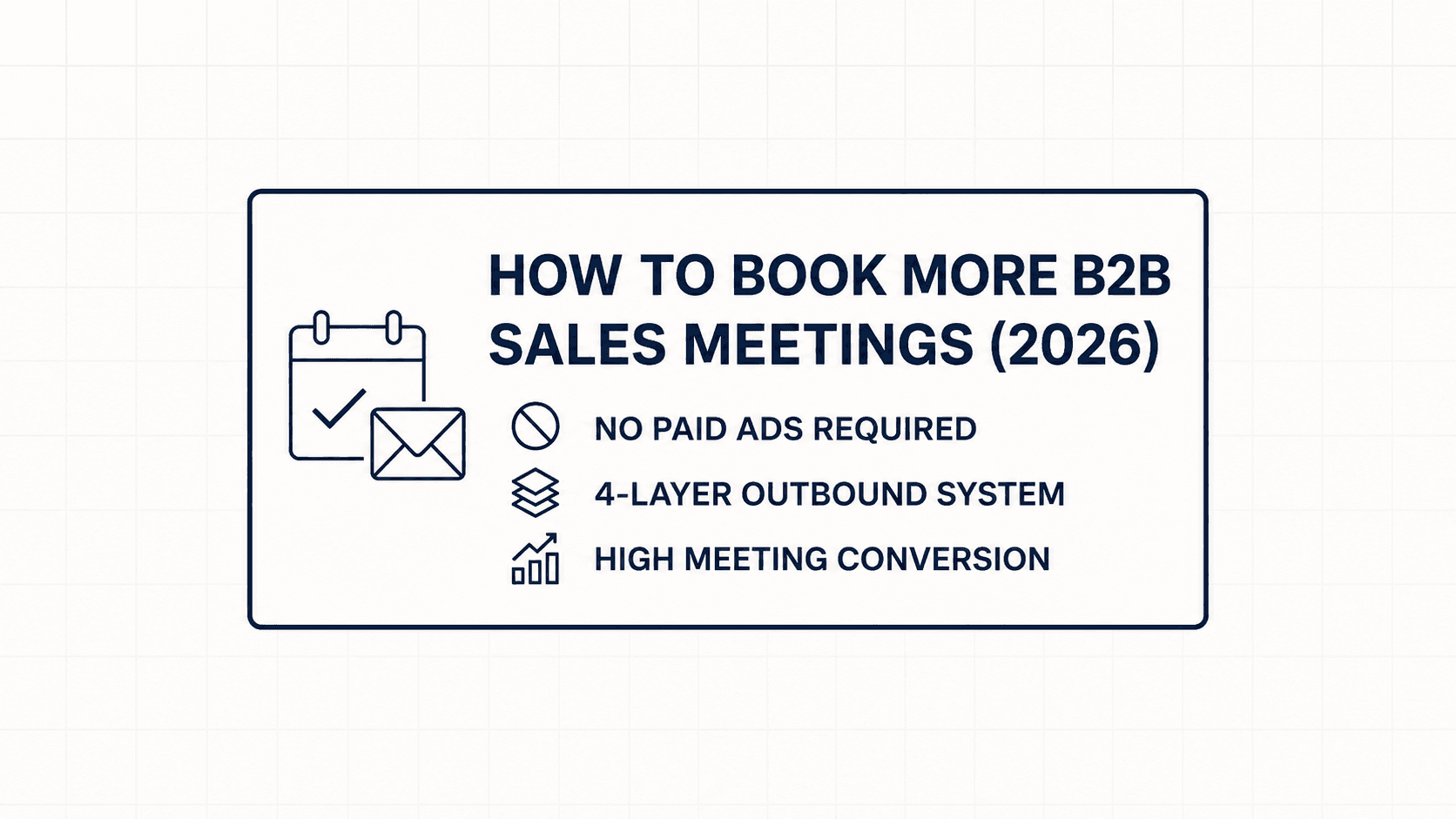
The 4-Layer B2B Outbound System That Books Meetings Consistently
Booking B2B sales meetings through cold outbound is not a volume problem. It is a systems problem. The teams that book meetings consistently are not sending more emails than everyone else. They are running a system where every layer is functioning before the next one is touched. Here is how that system is built.
Layer 1: Infrastructure
Infrastructure determines whether the email lands in the inbox or the spam folder. Every other layer in the system is irrelevant if this one is broken. Genuine Google accounts through a reputable inbox provider, properly warmed sending domains, and a reliable sequencer with correct technical configuration are the starting point. There is no copy optimization, no offer testing, and no follow-up sequence that recovers from emails that never get seen. The full technical breakdown of what correct infrastructure looks like is covered in the OutboundLeads email deliverability framework.
Layer 2: Strategy
Strategy is the answer to four questions that have to be resolved before a single email is written. Who is being targeted? Why this specific segment? Why does the offer matter to them right now? Why should they respond this week rather than next quarter? These four questions reverse-engineer every campaign decision: the copy angle, the lead magnet, the timing, and the call to action. Campaigns launched without clear answers to all four are campaigns launched without a structural reason to produce meetings.
Layer 3: Execution
Execution is list quality, copy, and sequence structure working together. The list has to be built from verified, enriched data that targets the exact ICP segment defined in layer two. The copy has to speak to a specific pain point, not a general industry problem. The cold email frameworks that generate consistent replies share one characteristic: they make it immediately clear the sender understands the recipient's specific situation, not just their job title.
Layer 4: Deployment
Deployment is the speed at which the system responds to live data. How fast can a reply be acted on? How quickly can a campaign be killed or pivoted when the numbers signal it is not working? At sufficient send volume, at least half of all replies to a cold email arrive within the first 24 hours. A campaign decision can be made within 24 hours of launch. Teams that wait for weekly review calls to assess campaign performance lose two to three weeks of send time on underperforming campaigns every single month.
Cold Outbound vs Paid Ads: Which Channel Books More B2B Meetings Per Dollar
Paid ads and cold outbound serve different functions in a B2B GTM strategy. Ads build awareness at scale. Outbound puts a specific message in front of a specific decision maker at a specific time. When the goal is a booked meeting with a named buyer, outbound wins on cost per meeting, targeting precision, and compounding return. Here is what the comparison looks like across the factors that matter most for pipeline generation.
Factor | Paid Ads | Cold Outbound |
|---|---|---|
Cost trajectory | Increases as audiences saturate and creative fatigues | Decreases as targeting sharpens and offer improves through data |
Feedback loop speed | Days to weeks depending on impression volume | 24 hours at sufficient send volume |
ICP targeting precision | Limited by platform data and audience size minimums | Title, company size, tech stack, intent signal, timing |
Compounding return | Stops the moment spend stops | Copy, data, and sequences improve with every campaign |
Platform dependency | Subject to algorithm changes and policy shifts | Owned system, no platform risk |
Decision maker access | Reaches whoever clicks, not necessarily the buyer | Targeted directly at named decision makers by title and signal |
Meeting quality | Varies based on audience match and ad creative | High when ICP and offer are correctly matched |
How to Build a B2B Outbound Offer That Gets Replies
The offer in the first cold email is not the product. The product is what the prospect buys after the meeting. The offer is the reason a person who has never heard of the sender would reply at all. Getting this distinction wrong is the most common reason technically sound outbound campaigns produce near-zero replies.
Start With ICP Clarity, Not Copy
An ICP defined only by industry and company size is not specific enough to write copy that earns a reply. The ICP definition that works for outbound goes deeper: which specific title is feeling the problem most acutely right now, what does a bad outcome cost them personally, and why would solving it be urgent enough to get on a call this week. The buyers who respond to cold outbound respond because the message proves the sender understands their specific situation better than other vendors do. That level of specificity comes from ICP work, not from copy optimization. A structured ICP definition process is the first step before any list is built or any sequencer is touched.
Build a Lead Magnet Worth Responding To
The lead magnet has to be worth something on its own before the product earns consideration. A specific audit, a benchmark report, a tool, a template that solves one problem in under ten minutes. OutboundLeads worked with a client whose product was objectively stronger than every competitor in their space. The campaigns were producing near-zero replies. After rebuilding the lead magnet and testing three new variants, signups increased 5x. The product did not change. The offer did. A well-targeted B2B lead list pointed at the wrong offer produces nothing regardless of send volume.
Match the Offer to the Segment, Not the Product
The same offer pushed to a different buyer segment consistently underperforms, even when the product solves the same problem for both. A VP of Sales and a VP of HR at the same company have different pain points, different decision criteria, and different reasons to get on a call this week. OutboundLeads has run campaigns where moving the same copy to a new segment produced zero results, not because the targeting was wrong but because the offer was built for the previous segment's pain point. The fix is not more volume. It is a new offer built specifically for the new segment.
Cold Email Infrastructure: Why Most B2B Outbound Programs Fail Before the First Send
In early 2026, a large portion of outbound operators using Azure panel setups had their entire sending infrastructure wiped. Accounts were mass-banned. Active campaigns stopped. Client pipelines collapsed. OutboundLeads had been monitoring bounce rate spikes inside the warm-up pools they operate within and identified the collapse in real time, having predicted it publicly months earlier.
The Azure panel approach was widely used because the upfront cost was lower than reputable alternatives. The actual cost when the infrastructure failed was categorically higher: full rebuilds, two to three weeks of campaign downtime per client, and churn from clients whose pipelines depended on those campaigns running. Cheap infrastructure is not a cost saving. It is a deferred cost with compounding consequences. For teams managing their own infrastructure, this breakdown of why cold emails go to spam covers the specific technical fixes that move emails back to primary inboxes.
Infrastructure decisions that protect B2B meeting rates:
Use genuine Google accounts through a verified inbox provider, not SMTP mailboxes, edu panels, or Azure reseller setups
Use reputable domain registrars for sending domains, not the cheapest available option
Monitor bounce rates daily inside warm-up pools as an early warning system before reply rates reflect the problem
Test deliverability with a dedicated tool before campaigns go live, not after the first send
Use a sequencer with warm-up protocols built in, not added on after the fact
How to Book More B2B Sales Meetings From the Pipeline You Already Have
60 to 70% of all B2B sales meetings booked through cold outbound come from follow-up sequences, not the first email. The first email opens the door. The sequence is what converts interest into a booked call. Most outbound programs stop too early, follow up with no new value, or run every touch the same way regardless of what the prospect engaged with. The result is a pipeline full of warm contacts that never convert.
OutboundLeads runs a follow-up sequence of 9 touches over 21 days across email, LinkedIn messages, and phone calls. Each touch adds value or creates urgency. None of them are check-ins. The sequence is built to give a prospect who was interested but distracted a specific reason to act now. Interest decays fast. The longer the gap between a positive signal and the next touch, the lower the probability that prospect converts to a meeting.
One of the highest-return optimizations inside a follow-up sequence is lead magnet order. OutboundLeads ran a campaign where the second email's lead magnet was consistently outperforming the first email's. Flipping the order produced a 600% increase in meetings booked. The targeting was identical. The copy was nearly identical. The only change was which offer appeared first in the sequence. For the complete architecture behind this, the scalable follow-up system guide covers the exact structure with real campaign data.
The follow-up mistakes that consistently kill B2B meeting rates:
Generic check-in messages. "Just following up" with no new angle teaches the prospect to ignore the next message.
Stopping after two or three touches. The data shows the majority of meetings come from touches four through nine. Stopping early means leaving most conversions on the table.
Touching the same prospect multiple times per day.Frequency without spacing reads as spam and drives unsubscribes from prospects who would have converted later.
No urgency mechanism across the sequence. Every touch that does not move the prospect toward a decision is a wasted send.
B2B Cold Outbound Benchmarks: What Good Looks Like
Most B2B teams running outbound have no reference point for whether their numbers are a system problem or a volume problem. These are the benchmarks OutboundLeads targets across client campaigns. If any metric is significantly below these numbers, the problem is in a specific layer of the system and can be diagnosed before more volume is added on top of it.
Metric | Benchmark Target | What It Signals If Below Target |
|---|---|---|
Meetings booked per emails sent | 1 qualified meeting per 300 emails sent | Offer, targeting, or follow-up sequence problem |
Human responses per contacts reached | 30 human responses per 10,000 contacts | Deliverability or copy problem |
Interested replies per human responses | 6 interested out of every 30 human responses | Offer or ICP targeting problem |
Meeting conversion from interested reply | 1 in 5 interested replies converts to a meeting | Follow-up sequence or response handling problem |
Reply speed after first send | 50%+ of replies within first 24 hours | Deliverability or send timing problem |
These benchmarks are the diagnostic layer of the system. When a campaign is underperforming, the benchmarks identify which layer to fix before the decision is made to kill the campaign or increase volume. A campaign producing replies but not meetings has a follow-up problem, not a deliverability problem. A campaign producing no replies despite correct infrastructure has an offer or targeting problem. The numbers tell you where to look.
The Outbound Tool Stack for Booking B2B Sales Meetings Without Paid Ads
These are the tools OutboundLeads uses across 3,000+ campaigns. Each is listed by function. No single tool replaces a functioning system, but using the wrong tool at any layer degrades every layer above it.
Function | Tool | Role in the System |
|---|---|---|
Inbox provider | Genuine Google accounts, reputable setup, zero mass bans in 2+ years of active use | |
Email sequencer | Campaign sequencing, sending management, reply tracking and routing | |
Deliverability testing | Spam and inbox placement testing before campaigns go live | |
Data enrichment and list building | Verified contact data, dynamic enrichment, and precise ICP list building | |
Workflow automation | Multi-step automations connecting outbound tools, CRM, and follow-up triggers | |
AI parallel dialer | Parallel dialing for SDR teams, projected to triple call volume per rep per week | |
Website visitor identification | Identifies anonymous website visitors for warm outbound follow-up triggers | |
AI email rewriting | AI-assisted email rewriting used inside automation workflows | |
Contact data enrichment | Contact verification and enrichment layered with Clay for list quality |
How to Get More B2B Sales: What Changes When the Outbound System Works
More B2B meetings do not automatically produce more B2B sales. The quality of the conversation matters as much as the volume of conversations. Outbound systems built around the right ICP, a validated offer, and a structured follow-up sequence produce meetings with buyers who already understand the problem and are actively looking for a solution. That is a categorically different sales conversation than one produced by generic high-volume blasting at an unqualified list.
The specific changes that move B2B revenue numbers when the outbound system is functioning correctly:
Offer quality replaces volume as the primary variable.A 2,000-contact campaign with a highly targeted, seasonally timed offer converted $30,000 MRR for OutboundLeads, equating to over $175,000 in lifetime value. The same send volume with a generic offer produces a fraction of that result.
Timing becomes a conversion variable. OutboundLeads ran a campaign targeting a seasonal industry by reaching out in late Q2, ahead of their Q4 and Q1 buying window. Because the outreach arrived before the buying decision opened, the campaign generated $30,000 MRR from 2,000 contacts. The same list reached during peak season competes with every other vendor who figured out the same timing.
Fast iteration replaces slow optimization. Campaigns that are not producing results get killed within 24 hours, not after a monthly review. The data to make that call is available in the first 24 hours at sufficient volume. Waiting longer does not produce better data. It produces more wasted sends on a campaign that already signaled it is not working.
The 95-5 Rule for B2B: Why Most of Your Market Is Not Ready to Buy Right Now
The 95-5 rule for B2B states that at any given time, only 5% of your total addressable market is actively in-market and ready to buy. The other 95% are not ready to purchase right now, even if they will eventually become buyers. This single fact explains why most outbound programs underperform and what to do about it.
Outbound programs built as if everyone on the list is in the 5% write copy that assumes urgency, assumes active evaluation, and asks for a commitment before building any reason to give one. When that approach reaches the 95% who are not ready, it generates low reply rates, high unsubscribe rates, and a negative brand association before the buying window opens.
Outbound programs that consistently book B2B sales meetings serve both groups differently within the same sequence. For the 5% who are ready, the offer is direct and the call to action is low-friction. For the 95% who are not ready yet, the offer delivers standalone value: a benchmark, a tool, an insight that solves one specific problem without requiring a sales conversation. The prospect who gets real value from a lead magnet today is the prospect who books a call when the buying window opens in three months, before the competition even knows they are in-market.
The 70/30 Rule in Sales and How It Applies to Cold Email Sequences
The 70/30 rule in sales states that effective salespeople should spend 70% of a conversation listening and 30% talking. In cold email, this principle applies to copy structure and sequence design in a direct and measurable way.
Cold emails that open with the sender's product, credentials, and request are talking at 100%. They give the prospect no reason to care before asking them to act. The emails that generate replies open with the prospect's situation, demonstrate understanding of their specific problem, and make the offer feel like a logical response to that problem rather than a pitch attached to it. 70% of the email is about the prospect. 30% is the solution and the ask.
The same ratio applies across the sequence structure. Early touches establish relevance and deliver something useful before asking for anything. Middle touches build urgency based on what the prospect engaged with. Final touches make a direct ask based on the context built across every previous touch. A sequence that opens with a hard pitch on every touch and escalates pressure without ever adding value earns unsubscribes, not meetings.
Outbound Running but Not Booking Meetings? The Problem Is in the System
3,000+ campaigns. $45M+ in pipeline. 50+ clients. The pattern in what books meetings and what does not is consistent across every industry, every ICP, every company size.
If your outbound is running and your calendar is not filling up, something specific is broken. Book a strategy call and we will find it.