
Jacob Bowman
300 emails. One qualified meeting. That is the ratio a well-run B2B cold outreach campaign should hit. If you are sending at volume and not getting close to that number, your reply rate is telling you something is broken.
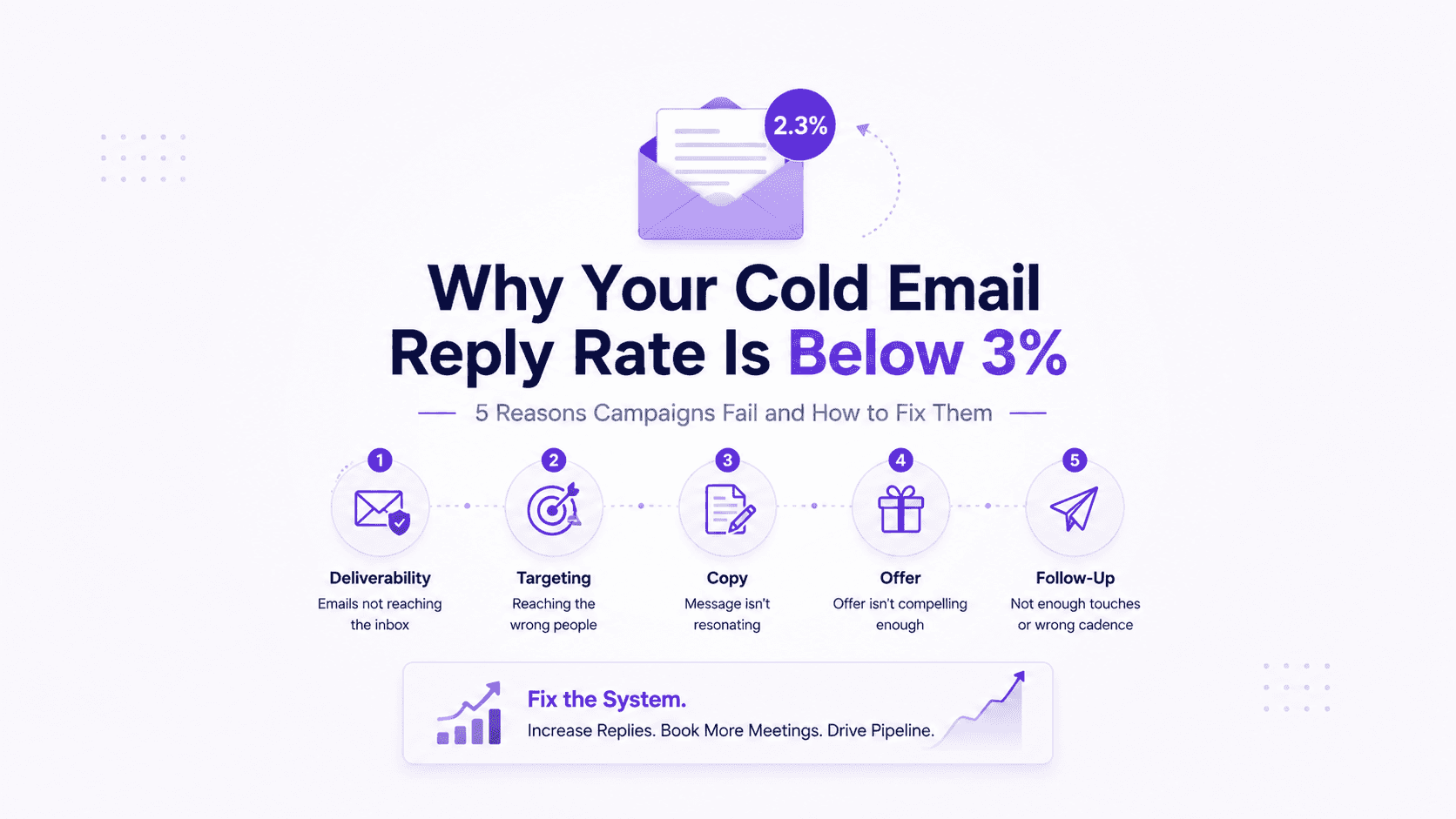
Below 3% is not a copywriting problem. It is not a channel problem. It is a systems problem. Something in your infrastructure, your targeting, your copy, your follow-up, or your read on the data is off. Usually more than one of those at once.
This post breaks down the five reasons reply rates collapse and exactly what to do about each one. The diagnosis comes from running 3,000+ campaigns across B2B markets with $45M+ in pipeline generated. The fixes are specific, not theoretical.
What Is a Good Cold Email Reply Rate in 2026?
Before diagnosing what is broken, you need a baseline. Here are the numbers a well-run B2B cold email campaign should hit:
Total reply rate: 3-8% depending on market, volume, and offer
Positive reply rate: at least 20% of all replies should express genuine interest
Meeting conversion: 1 in 5 positive replies should convert to a booked call
Emails to meeting ratio: roughly 1 qualified meeting per 300 emails sent
Bounce rate: under 2% consistently
According to Instantly's 2026 Cold Email Benchmark Report, top performers exceed 10% reply rates, 2-4x higher than the platform average of 3.43%. A rate above 5% puts you ahead of most B2B senders. Above 8% means you have found strong ICP-offer fit.
Industry context shifts these numbers considerably. SaaS and software campaigns often land under 2% due to inbox saturation at the decision-maker level, while agency services, recruiting, and professional services consistently run at 4-8% with tight targeting. If you are selling into SaaS, a 3% rate with a 25% positive reply conversion is a much better signal than a 7% rate with 5% positive replies.
Why a High Reply Rate Can Still Mean a Broken Campaign
Reply rate is a vanity metric if you are not tracking what those replies convert into.
One client campaign ran at 7-9% total reply rate with a 20% positive reply rate. By every surface metric, it looked strong. Meetings booked: near zero. The problem was not the targeting and it was not the copy. It was the follow-up response. The reply sent after a positive lead responded was too long, presented too many options, and gave the prospect nothing clear to decide on. They said yes to the email and then fell off when the response overwhelmed them.
The fix was reconstructing the follow-up message around a single decision. One ask. One next step. Meetings started converting.
Track reply rate, positive reply rate, and meeting conversion as three separate metrics. Each has a different diagnostic and a different fix.
Reason 1: Your Emails Are Not Reaching the Inbox
Infrastructure is the foundation of outbound. If your emails are not landing in inboxes, nothing else matters. You can have the best copy, the most targeted list, and a compelling offer. It is all irrelevant if the email never gets seen.
Why Are My Cold Emails Going to Spam?
The most common infrastructure mistakes that kill deliverability are using cheap SMTP mailboxes instead of real Google accounts, building on Azure panel setups or legacy accounts, sending from new domains without a proper warmup period, skipping email validation before sending, and missing SPF, DKIM, and DMARC authentication records.
The Azure panel issue is not hypothetical. In early 2026, accounts running Azure panel setups got mass-wiped. It was visible in real time inside sending warm-up pools: a sudden spike in bounces pointing back to Outlook accounts where the tenant no longer existed. Teams lost weeks of sending progress and had to rebuild infrastructure from scratch. Panel setups and legacy accounts are cheap upfront. The cost of rebuilding, plus two to three weeks of zero sends, far exceeds whatever was saved on setup.
Since February 2024, Google and Yahoo have required all bulk senders to have SPF, DKIM, and DMARC in place. Microsoft followed with equivalent rules in May 2025. Google's sender guidelines make clear that non-compliant messages are now rejected at the SMTP level entirely, not filtered to spam. Spam complaints must stay under 0.3% and bounces under 2%.
How to Fix Cold Email Deliverability
Use real Google accounts from a reputable account reseller, not panel setups or legacy accounts
Set up SPF, DKIM, and DMARC on every sending domain before any sends go out
Warm new domains gradually: start at 5-10 emails per day and increase over 4-6 weeks
Validate every email address before it touches your sequence; remove role accounts, catch-alls, and bad data
Distribute sends across multiple domains so no single domain gets overloaded
Monitor bounce rates in real time; if you cross 2%, pause and clean the list before continuing
Fully authenticated domains with DMARC configured are 2.7 times more likely to reach the inbox compared to unauthenticated domains. New domains aged 6-12 months before launch see inbox placement improve by up to 30 percentage points versus domains sent at volume immediately after setup.
Reason 2: You Are Targeting the Wrong People
You can have clean infrastructure and strong copy and still get a 1% reply rate. If the email is going to the wrong people, it will not convert.
How Does ICP Definition Affect Cold Email Reply Rates?
Broad ICP targeting is one of the most expensive mistakes in B2B outbound. The problem is not just reaching people who cannot buy. It is reaching people for whom the pain your offer solves is not the right pain.
Consider a product that can be sold to sales, marketing, and HR teams. The offer is the same. But the reason a sales leader buys it is completely different from the reason an HR leader buys it. Take copy that works for one and push it to the other without adjusting: the reply rate collapses. Not because the offer is weak. Because you are presenting a piece of steak to someone who does not eat meat. They are both hungry. You need two different meals.
Vague ICP: "We target mid-market SaaS companies."
Useful ICP: "We target VP of Sales at SaaS companies between $5M-$50M ARR who are running outbound with a team of 3-5 reps and struggling with reply rates and meeting conversion."
The more specific the segment, the more your email speaks directly to a pain that feels personal. When someone reads your cold email and thinks "this person gets exactly what I am dealing with," that is when reply rates move.
How to Build a B2B Cold Email List That Converts
Pulling a list from Apollo and hitting send is not a targeting strategy. A process that produces quality lists looks like this:
Define your segment with specificity: title, company size, industry, and ideally a trigger signal such as recent funding, a new hire in a relevant role, or a product launch
Source data from a primary tool like Apollo or Clay, then enrich it through a secondary layer like BetterContact to maximize verified contact data
Validate every email address before the sequence loads; remove bad data, role accounts, and catch-all domains
Separate personas into distinct campaigns: sales leaders get one campaign, marketing leaders get another, even if both can use the product
Smaller, tightly targeted lists consistently outperform high-volume blasts. Campaigns with precise targeting average a 5.8% reply rate versus 2.1% for large untargeted sends. Volume is not a substitute for targeting precision.
Reason 3: Your Copy Is Not Doing Enough Work
The email itself is where most operators spend too much time trying to be clever and not enough time being clear.
What Makes Cold Email Copy Convert?
The best-performing campaigns average fewer than 80 words per first-touch email. Brevity forces clarity. Every word must earn its place. Beyond length, three things determine whether copy converts:
One idea, one CTA. Not three offers, not a product overview, not a list of features. One ask that is easy to say yes or no to.
A specific, relevant pain in the opening line. Not a generic hook about "scaling revenue." The pain has to feel like it was written for that exact persona at that exact moment.
A subject line that earns the open. Generic subject lines get ignored. Clickbait subject lines get opens but not meetings. No one buys a CRM because the subject line compared them to someone on a scandal list. It takes 20 years to build a reputation. Stunts like that destroy it in 20 seconds.
A first name and company name dropped into a template is a mail merge. Real personalization means your message reflects a genuine understanding of that buyer's specific situation: their role, their current challenge, and why the timing is relevant now.
What Is a Strong Cold Email Offer?
The offer is not "book a call." The call is the ask. The offer is what you are giving them in exchange for that call: a demo, a benchmark report, a specific audit, a resource that gives them something before they commit to any conversation. Something that makes them think: that is worth 20 minutes of my time.
Signs your offer is weak: you are getting replies but almost none convert into meetings, prospects respond with "not interested" without asking a single question, or you are seeing a 7-8% total reply rate with only 5% positive replies.
Test at least three to five offer variants before concluding the channel does not work. In one case, switching the order of two lead magnets in a follow-up sequence produced a 600%+ increase in meeting bookings. The first email was already getting replies. The second offer was resonating more. Flipping them meant more people got the stronger hook at the first touchpoint and the sequence snapped into alignment. Small adjustments like that are what real optimization looks like.
Reason 4: Your Follow-Up Sequence Is Leaving Most of Your Pipeline on the Table
At least 60-70% of all meetings booked through outbound come from follow-up sequences, not the first email. If you are treating follow-up as an afterthought, you are leaving the majority of your pipeline unworked.
How Many Follow-Up Emails Should I Send?
50% of replies to a first-touch cold email arrive within 24 hours. That gives you fast signal on whether the first email is working. For the other 50% of potential respondents, they have not replied yet but may still. The follow-up sequence is where you reach them.
The cadence that works: 9 touches across multiple channels over roughly 9 days after a positive reply. Email, phone, LinkedIn. Not consecutive daily blasts. Not the same message re-sent three times. Spaced, multi-channel, each touch adding something new. Persistence crosses into spam when you are hitting the same inbox multiple times a day, every day.
What Should a Cold Email Follow-Up Say?
The most common follow-up mistake is sending nothing new. Just "following up on my previous email" is a reminder that you exist, not a reason to respond. Each follow-up touchpoint should add something: a different angle, a relevant case study, a second offer, or a specific reason why now matters. It should create urgency without pressure, push toward a clear decision, and be spaced across 2-3 weeks rather than sent back-to-back on consecutive days. For a full breakdown of how to build this system, read How to Build a Scalable Follow-Up System (With Real Outbound Data).
Reason 5: You Are Misreading Your Own Data
Reply rate alone tells you almost nothing about what is wrong. You need to look at three metrics separately to get an accurate diagnosis.
How to Diagnose a Cold Email Campaign That Is Not Working
The three metrics that matter are total reply rate (are people responding at all?), positive reply rate (of those who respond, how many are expressing genuine interest?), and meeting conversion rate (of those who express interest, how many are booking a call?).
Each failure mode has a different fix:
Low total reply rate: deliverability problem, copy problem, or both
High total reply rate but low positive reply rate:targeting is off or the offer is not resonating with this audience
High positive reply rate but low meeting conversion: the follow-up response is too long, too complex, or not driving a clear decision
If you are only looking at reply rate as a single number, you cannot tell which of these three problems you have. Diagnosing the wrong one wastes weeks.
When Should You Kill a Campaign and Start Fresh?
The answer is not "give it more time." A well-run campaign shows meaningful signal within the first 24 hours of sending at volume, with at least 50% of first-touch replies coming in during that window. Kill the campaign when any of the following are true:
Bounce rate has crossed 3% and list hygiene fixes have been exhausted
Total reply rate is under 1% after 500+ sends with validated infrastructure
Positive reply rate has not moved above 10% after multiple copy and offer tests
Meeting conversion is consistently under 10% despite follow-up restructuring
Kill when the data confirms the core hypothesis is wrong, not when you are impatient. The difference is having clear thresholds before launch, not making judgment calls mid-campaign based on gut feel.
If you are evaluating a partner for this work, read How to Choose a B2B Outbound Agency: 7 Questions to Ask Before Signing to understand what a diagnostic-first approach looks like in practice.
Cold Email Reply Rate Benchmarks by Industry (2026)
These numbers reflect total reply rates across campaigns with validated infrastructure, verified lists, and tested copy. They are directional. Market, offer, and volume all affect where you land within or outside these ranges.
Industry | Average Reply Rate | Notes |
|---|---|---|
SaaS / Software | 2-5% | Highest inbox competition; decision-makers receive more cold email than any other vertical |
Agency Services | 4-7% | Tangible offer helps; prospects can quickly assess relevance |
Recruiting / Staffing | 5-8% | Built-in relevance; timing signals matter |
Professional Services | 4-7% | Trust and specificity of offer carry significant weight |
Legal Services | Up to 10% | Highest-performing vertical in recent benchmarks |
Financial Services | 3-6% | Compliance sensitivity; specificity of targeting is critical |
If you are in SaaS and hitting 3-4% with a 25% positive reply rate, that is a stronger outcome than 7% total replies with 8% positive replies. The ratio matters more than the top-line number.
How OutboundLeads Diagnoses and Fixes Cold Email Reply Rates
Across 3,000+ campaigns and 20,000+ verified leads, the pattern of what breaks reply rates is consistent. It is almost never one thing. It is usually a combination of infrastructure gaps, targeting assumptions that have not been tested, and copy or offer that is not differentiated enough for the specific buyer persona receiving it.
The diagnostic framework runs across four layers.
Infrastructure: are emails landing in inboxes? This means auditing domain authentication, sender reputation, warmup status, bounce rates, and account setup. If this layer is broken, no other fix matters.
Strategy: is the campaign reaching the right buyer with an offer that matches their specific pain? This covers ICP definition, persona segmentation, offer development, and message-market fit.
Execution: is the system built correctly? This covers list building, data enrichment, email validation, copy and sequence design, and offer variant testing.
Deployment:how fast can the team act on what the data shows? Speed of iteration on underperforming campaigns and speed of response to positive replies both directly affect pipeline output.
This is what $45M+ in pipeline built from cold outreach looks like in practice: every layer working, with the ability to diagnose which one is failing when results fall short of target.
Frequently Asked Questions About Cold Email Reply Rates
What is a good cold email reply rate in 2026?
A total reply rate of 3-8% is healthy for most B2B cold email campaigns. Above 5% puts you ahead of the majority of B2B senders. Above 8% typically signals strong ICP-offer fit. Reply rate alone is not the number to optimize: at least 20% of your replies should be positive, and at least 1 in 5 positive replies should convert to a booked meeting.
Why is my cold email reply rate so low?
Low reply rates are caused by one or more of five problems: emails are not reaching inboxes, targeting is too broad or reaching the wrong persona, copy does not speak to the buyer's specific pain, the offer is not compelling enough to prompt a response, or the follow-up sequence is not creating enough value. Start the diagnosis at infrastructure: if your bounce rate is above 2%, fix that before anything else.
How do I improve my cold email open rate?
Open rate is an unreliable metric in 2026. Apple Mail Privacy Protection preloads tracking pixels automatically, inflating open rate data significantly. Treat it as a directional signal only. Focus optimization energy on reply rate, positive reply rate, and meeting conversion. If you want to move open rates, improve subject line relevance by referencing a specific problem or situation that matters to that exact prospect.
How many cold emails should I send per day?
For new domains, start at 5-10 emails per day and ramp gradually over 4-6 weeks. For established infrastructure with warmed domains, the right volume depends on your target market size and list quality. Sending volume is not a substitute for targeting precision.
Why are my cold emails going to spam?
The most common causes are missing or misconfigured SPF, DKIM, and DMARC records, bounce rates above 2%, spam complaint rates above 0.3%, sending from unwarmed domains, and using cheap panel or legacy account setups. Fix authentication first, then list quality, then infrastructure. Copy-level spam triggers are typically the last problem, not the first.
What is the difference between reply rate and positive reply rate?
Reply rate measures all responses including negative ones such as "not interested" or "remove me." Positive reply rate measures only responses that indicate genuine interest or intent. A campaign can show a 7% reply rate with only 5% of those being positive, which signals a targeting or offer problem. Positive reply rate is the metric that connects most directly to pipeline.
How long should a cold email be?
Under 80 words for the first-touch email. One idea, one ask. Longer emails give the prospect more options to disengage from and more complexity to feel overwhelmed by.
Does personalization improve cold email reply rates?
Yes, but the type of personalization matters. A first name and company name dropped into a template is a mail merge. Real personalization means your copy reflects a genuine understanding of what that specific buyer is dealing with: their role, their current challenge, and why your offer is relevant to them right now. Personalization at the ICP level consistently outperforms token-level substitutions.
If Your Reply Rate Is Below 3%, Here Is the Next Step
Below 3% means one or more layers of your outbound system are broken. The fix starts with knowing which one. Infrastructure, targeting, copy, follow-up, and data interpretation each fail in different ways and each require a different response.
OutboundLeads has run this diagnostic across 3,000+ campaigns. We have booked meetings at Apple, Supabase, Workday, and KPMG. The process is not complicated, but it requires running it correctly from the infrastructure up.
If you want to know exactly where your reply rate is breaking down and what the fix looks like for your specific market and offer, book a strategy call with our team. We will walk through your current setup, identify the failure points, and tell you what we would do differently.