Aylin Bezirgan
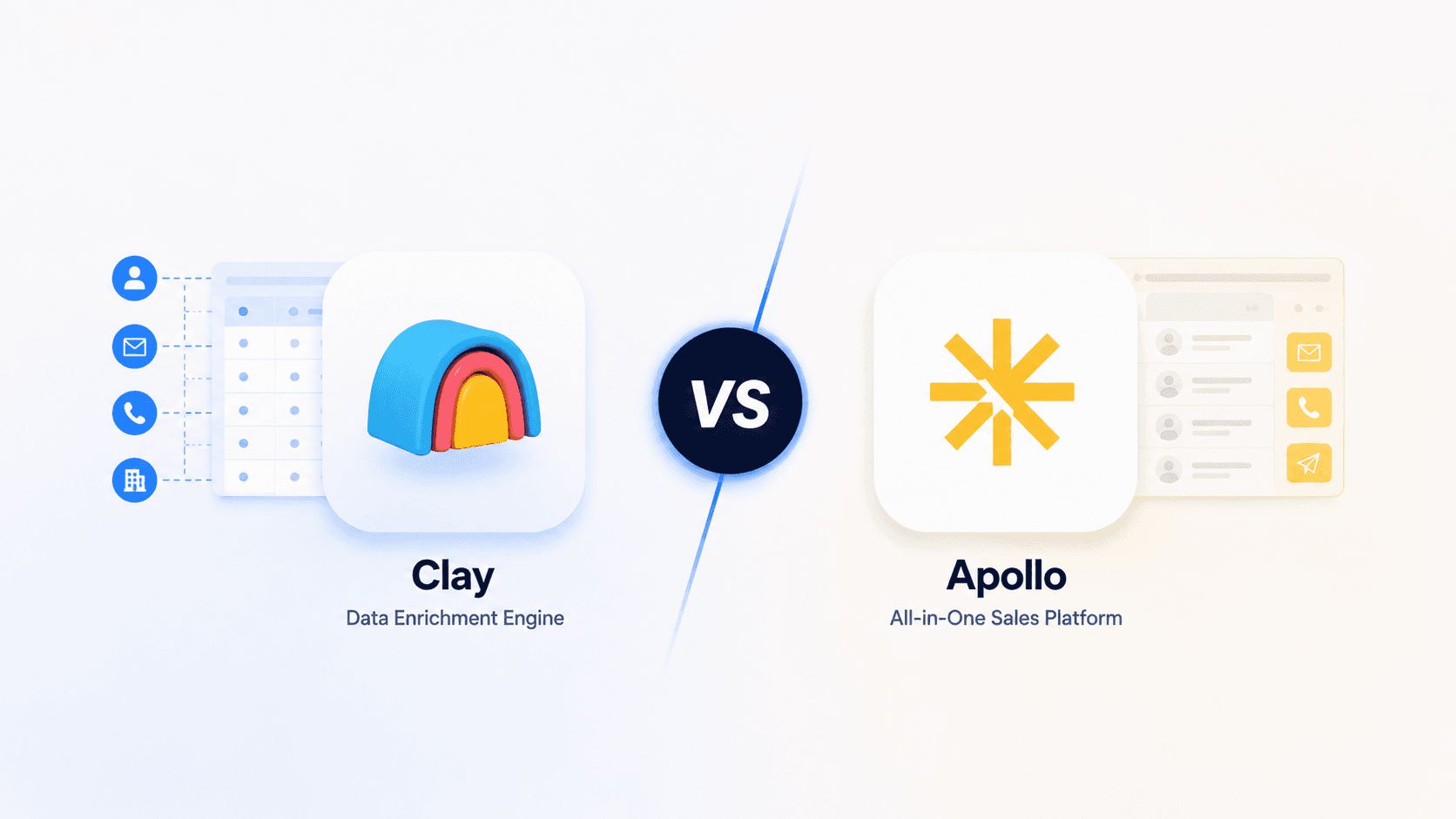
Clay waterfall enrichment achieves 85 to 92% email find rates. Apollo single-source lands at 60 to 75%. That gap is not a rounding error. It is the difference between 5 to 10% bounce rates that get your domain flagged and 0.8 to 1.4% bounce rates that hold across 3,000+ campaign sends. These are not the same tool. Choosing the wrong one for your use case does not just waste money. It burns your sending infrastructure. Here is how they compare.
Clay vs Apollo: Quick Comparison (2026)
Category | Clay | Apollo |
|---|---|---|
Primary function | Data enrichment and workflow automation | All-in-one prospecting and outreach |
Database size | No native database; pulls from 150+ providers | 275M+ contacts (proprietary) |
Email find rate | 85 to 92% (waterfall) | 60 to 75% (single source) |
Email accuracy | ~95% verified | ~92% self-reported (lower in practice for niche ICPs) |
Bounce rate (real-world) | 0.8 to 1.4% | 5 to 10% |
Reply rates (typical) | 5 to 8% | 1 to 2% |
Built-in sequencing | No (integrates with Instantly, Lemlist, etc.) | Yes |
Built-in dialer | No | Yes |
CRM integration | HubSpot, Salesforce, Pipedrive (Growth plan+) | HubSpot, Salesforce (Basic plan+) |
Starting price | $167/mo (Launch, annual) | $49/user/mo (Basic, annual) |
Best for | Teams with defined ICP needing high-accuracy enrichment | Teams wanting one tool for prospecting and outreach |
G2 comparison: Apollo.io vs Clay
What Clay and Apollo Do (They Are Not the Same Tool)
The most common mistake in this comparison is treating them as direct competitors. They are not.
One is a database with outreach built on top. The other is an enrichment engine that connects to 150+ databases, including the first one. They overlap in one area: both can be part of building a lead list. That is where the similarity ends. The decision is not which one to pick. It is knowing which job each one is built for, and whether you need one or both.
Apollo.io: All-in-One Sales Database and Outreach Platform
Apollo is a proprietary B2B contact database with 275 million contacts, built-in email sequences, a dialer, and AI writing assistance. It was built for individual contributors and small-to-mid sales teams that want one login for prospecting and outreach.
The workflow is: search and filter contacts from Apollo's database using firmographic and demographic filters, add them to a sequence, send from Apollo, and manage everything inside one dashboard. For a founder running their own outbound or a five-person sales team that needs to start booking meetings without stitching together four tools, Apollo is the fastest path from zero to first email sent.
Core strength: speed. You can go from no list to 500 contacts in a sequence in under an hour.
Core limitation: single-source data. If Apollo does not have a verified email for a contact, you have no fallback.
Accuracy degrades for niche ICPs, sub-500 employee companies, and contacts outside North America.
If you are building a prospecting workflow from a single database, read How to Generate High-Quality B2B Leads for what high-quality lead generation looks like at scale.
Clay: Data Enrichment and Workflow Automation Engine
Clay is a programmable spreadsheet that connects to 150+ data providers and runs waterfall enrichment across them. It supports conditional logic, AI personalization, and automated routing. It was built for growth teams and agencies that already have outreach tools and need better data quality feeding into them.
The workflow is: import a list from Apollo or another source, run waterfall enrichment across multiple providers (Apollo, Hunter, Dropcontact, People Data Labs, and others), personalize with AI based on job title, company signals, or hiring activity, and push the enriched list to a sequencer like Instantly or Smartlead.
Core strength: data accuracy and workflow flexibility. Clay does not rely on one database. It asks ten databases in sequence and stops when it finds a verified answer. That is why its real-world bounce rates run 0.8 to 1.4% while single-source tools run 5 to 10%.
Core limitation: no native sending. You need a separate outreach tool. Clay also has a steeper learning curve and takes more setup time before your first campaign goes out.
For a detailed breakdown of how list quality connects directly to campaign performance, read How to Build a B2B Lead List That Converts.
Clay vs Apollo Pricing in 2026
Both tools changed their pricing significantly in 2026. Here is what each costs at the volume a B2B outbound team runs.
Clay Pricing After the March 2026 Overhaul
Clay restructured its entire pricing model on March 11, 2026. The old Starter, Explorer, and Pro tiers no longer exist for new customers.
Plan | Monthly Price (Annual) | Data Credits/mo | Actions/mo | Key Features |
|---|---|---|---|---|
Free | $0 | 100 | 500 | Up to 200 rows per table, unlimited seats |
Launch | $167 | 2,500 | 15,000 | Phone enrichment, signal tracking, email integrations |
Growth | $446 | 6,000 | 40,000 | CRM sync (HubSpot, Salesforce, Pipedrive), HTTP API, Web Intent signals |
Enterprise | Custom ($30K to $154K+/year) | Custom | Custom | Volume contracts, dedicated support |
The March 2026 overhaul also reduced data marketplace costs by 50 to 90% across most providers. Real-world cost for a team enriching 2,000 to 5,000 contacts per month: expect $350 to $600/month on Launch or Growth.
Apollo.io Pricing in 2026
Plan | Price (Annual) | Data Credits/year | Key Features |
|---|---|---|---|
Free | $0 | 10,000 email credits/mo | 2 active sequences, Gmail integration only |
Basic | $49/user/mo | 5,000 | Unlimited sequences, CRM integration, open and click tracking |
Professional | $79/user/mo | 10,000 | AI email writing, dialer with call recording, advanced Salesforce sync |
Organization | $119/user/mo | 15,000 | 200 mobile credits/mo, international dialer, custom reports |
Per-user pricing scales directly with headcount. A 5-person team on Apollo Professional costs $395/month. That same team using Clay Growth pays $446/month total for the entire workspace, not per seat. Factor in $150 to $400 per user per month for serious volume when overages are included.
Which Tool Is More Expensive?
For a 5-person team running 3,000 contacts per month: Apollo Basic runs $245/month (5 seats) before overages. Clay Launch runs $167/month per workspace before enrichment credits. Add a sending tool (Instantly or Smartlead at $97 to $197/month) and the full Clay stack runs $264 to $364/month. The question is not which line item is smaller. A Clay-enriched list with 0.8 to 1.4% bounce rates will outperform an Apollo-only list with 5 to 10% bounce rates regardless of the pricing comparison. Domain damage is expensive to repair. List quality prevents it.
Clay vs Apollo Data Accuracy: What the Numbers Show
This is where the two tools diverge most sharply. It is also the number that determines whether your list helps your campaign or kills your domain.
Apollo Email Accuracy in Practice
Apollo reports 92% email accuracy and 88% on phone numbers. Those figures reflect the best-case scenario: North American mid-market contacts in well-covered verticals.
In practice, accuracy drops for niche ICPs. Companies with under 500 employees. Non-US markets. Contacts in verticals where Apollo's database coverage is thinner. Real-world bounce rates on Apollo-sourced lists run 5 to 10%. That matters for a specific technical reason: Google and Yahoo bulk sender requirements in 2026 require staying under a 0.3% spam rate to maintain deliverability. A 5 to 10% bounce rate starts a domain degradation cycle that is expensive and time-consuming to reverse.
High bounce rates are one of the most common upstream causes of campaigns failing at the delivery stage. Read Cold Emails Going to Spam: Why and How to Fix It for a full breakdown of what each failure mode looks like.
Clay Waterfall Enrichment: Why the Hit Rate Is Higher
Waterfall enrichment is a sequence of data providers queried in order until a verified result is found. Instead of relying on one database, you query a second, a third, a fourth, stopping only when you have a confirmed and validated result.
A standard Clay waterfall runs: Prospeo first, then Findymail, then Datagma, with NeverBounce validation at the end of the chain.
The results by the numbers:
Email find rates: 85 to 92% vs 60 to 75% from a single source
Verified benchmark: running 10,000 Apollo-sourced contacts through a Clay waterfall recovered valid emails for 23% of contacts Apollo had marked risky or missing
Bounce rate outcome: 0.8 to 1.4%, inside the safe zone for bulk sending at any volume
Phone data: under 5% wrong number rate with multi-provider waterfall vs approximately 30% dead numbers with single-source providers
One trade-off to account for: accuracy gains cost credits. Enriching 10,000 contacts through a full Clay waterfall draws significantly from your Data Credit pool. Factor that into any cost comparison.
Clay vs Apollo for Lead List Building: Use Case Breakdown
Use Case | Better Tool | Why |
|---|---|---|
Building a cold list from scratch, fast | Apollo | Built-in database of 275M+ contacts; search and export in minutes |
Enriching an existing CRM or partner list | Clay | Waterfall across 150+ providers fills gaps Apollo misses |
Targeting niche ICPs (sub-500 employees, EMEA, SMB) | Clay | Apollo accuracy drops; waterfall maintains 85%+ find rate |
High-volume outbound (10K+ contacts per month) | Clay | Lower bounce rates protect domain health at scale |
Teams without a dedicated outreach tool | Apollo | Sequencing, dialer, and CRM in one platform |
Agencies managing multiple clients | Clay | Workflow customization, table-based structure, multi-client logic |
Teams new to outbound with no tooling budget | Apollo (Free) | 10,000 email credits per month free; includes sequences |
RevOps teams with existing Salesforce or HubSpot | Both | Apollo for prospecting, Clay for enrichment feeding into CRM |
When Apollo Is the Right Choice
Apollo makes sense when you are still figuring out your ICP and need speed to first contact. It is the right tool for:
Founders or individual AEs running their own prospecting without a dedicated ops function
SMB sales teams of 5 to 10 people that want one platform to cover prospecting, sequences, and calls
Teams that cannot yet justify a multi-tool stack and need something that works end-to-end
Campaigns targeting North American, mid-market contacts where Apollo's data coverage is strongest
Anyone starting from zero who needs to get emails sent this week, not after a month of stack configuration
When Clay Is the Right Choice
Clay becomes the right tool once your ICP is locked and you are optimizing for data quality over setup speed. It is the right tool for:
Agencies enriching lists across multiple clients, each with different ICP requirements
RevOps teams building systematic workflows where enriched data needs to flow into Salesforce or HubSpot
In-house outbound teams sending at volume where domain health is a genuine operational risk
Niche ICPs where Apollo's single-source accuracy is too low to produce clean sends at scale
Any team that has already experienced the domain degradation cycle that follows from sustained high bounce rates
If you have not yet defined who you are targeting with precision, start with Ideal Customer Profile: How to Define Yours. Once that is set and validated, moving to Clay enrichment is the obvious next upgrade.
Can You Use Both? The Clay + Apollo Stack
Most teams running serious outbound at scale use both. Apollo for prospecting. Clay for enrichment. A dedicated sender for delivery.
Here is how the stack works in practice:
Build your prospect list in Apollo using filters (job title, company size, industry, revenue range, technology used)
Export the list into Clay
Run waterfall enrichment in Clay across 5 to 10 providers to verify emails and fill gaps
Layer in AI personalization based on job title, company news, hiring signals, or recent funding
Push the enriched, validated list into Instantly or Smartlead with per-segment send limits and warmup in place
Full stack cost for a 5-seat team: Apollo Basic ($245/month) + Clay Growth ($446/month) + sending tool ($97 to $197/month) = $788 to $888/month before overages.
For a full breakdown of how the tools in a modern outbound stack fit together, read Top 5 AI GTM Tools in 2026.
After running 3,000+ campaigns across 50+ clients, the pattern is consistent: the teams hitting below 1.5% bounce rates and above 5% reply rates are running waterfall enrichment on every list before it goes to send. The tool selection matters. The operator decisions behind it matter more.
What Neither Clay Nor Apollo Solves
Both tools handle the data layer. Neither one handles the rest of what determines whether a campaign produces pipeline.
Copy. A perfectly enriched list with a generic email produces generic results. Clay does not write the message. Apollo does not construct the offer. The data quality problem and the copy problem are separate, and solving one does not solve the other.
Deliverability infrastructure. Domains, inboxes, warmup pools, and send volume ramp are entirely separate from where your data comes from. A clean list sent from a misconfigured domain on a cold mailbox fails the same way as a bad list sent from healthy infrastructure.
For a full breakdown of why reply rates stay low even after the list problem is solved, read Why Your Cold Email Reply Rate Is Below 3%. For the infrastructure side, the full framework is in How to Improve Email Deliverability for Cold Outreach.
Segment prioritization. Neither tool decides which 500 contacts out of a 10,000-person list deserve your first send. That decision drives results more than which enrichment tool you used. Volume scales the problem if your targeting is off.
The data layer is table stakes. The operator layer is where results live.
Clay vs Apollo: Frequently Asked Questions
Is Clay better than Apollo for B2B lead generation?
They solve different problems. Apollo is a database and outreach platform. Use it to build lists fast. Clay is an enrichment engine. Use it to improve the accuracy of lists you already have. Early stage with ICP still being refined: Apollo. Defined ICP, optimizing for data quality at volume: Clay.
Can Clay replace Apollo?
No. Clay has no native B2B contact database for prospecting from scratch. You still need a data source, and Apollo is one of the most commonly used inputs into a Clay workflow. Clay enriches and verifies data. It does not replace the need for a source list.
Can Apollo replace Clay?
For basic prospecting, yes. For high-volume outbound where data quality is a constraint, no. Apollo's single-source accuracy drops for niche ICPs and non-US markets. Clay's waterfall approach handles the gaps Apollo cannot fill.
What is waterfall enrichment and why does it matter?
Waterfall enrichment queries multiple data providers in sequence until a verified result is found. Clay's waterfall approach brings email find rates from 60 to 75% (single source) to 85 to 92%, and reduces bounce rates from 5 to 10% down to 0.8 to 1.4%. At volume, that gap is the difference between hitting Google's spam thresholds and staying clean across every domain you run.
How much does Clay cost compared to Apollo in 2026?
Clay's Launch plan starts at $167/month (annual) for a workspace, not per user. Apollo's Basic plan starts at $49/user/month. For a 5-person team, Apollo Basic is $245/month vs Clay Launch at $167/month. Real costs run higher for both. Apollo credit overages push total cost to $150 to $400 per user per month for active outbound teams. Clay Growth at $446/month is the realistic entry point for teams enriching 5,000+ contacts per month.
Does Apollo have waterfall enrichment like Clay?
No. Apollo uses its own proprietary database exclusively. It does not chain multiple providers in sequence. What you see in Apollo is what Apollo has. There is no fallback enrichment layer built in.
Which tool is better for cold email deliverability?
Clay-enriched lists produce lower bounce rates (0.8 to 1.4%) compared to Apollo-sourced lists used without additional enrichment (5 to 10%). Neither tool manages your sending infrastructure. Domains, inboxes, and warmup are separate problems. Read How to Improve Email Deliverability for Cold Outreach for that framework.
What is the best B2B data tool for cold email in 2026?
For most teams, the answer is both. Apollo to build and filter prospect lists, Clay to enrich and verify them before they go to a sequencer. If you can only use one: Apollo if you are starting from scratch and need contacts immediately. Clay if you already have a list and need to maximize accuracy before the first send.
The Verdict: Clay vs Apollo for Lead List Building
Apollo gives you speed. 275 million contacts, built-in sequences, a dialer. All in one login.
Clay gives you accuracy. Waterfall enrichment across 150+ providers. 85 to 92% email find rates. 0.8 to 1.4% bounce rates that hold at volume.
The teams consistently hitting 5 to 8% reply rates are not choosing between them. They are running Apollo to build and Clay to enrich.
Choose Apollo if you are in early-stage prospecting, still validating your ICP, or running a small team that needs one tool to cover everything. Choose Clay if your ICP is defined, your list accuracy is a bottleneck, and your bounce rates are climbing above 3%. Use both if you are running serious volume and domain health is something you cannot afford to get wrong.
Neither tool replaces the operator behind the stack. The ICP definition, the offer construction, the copy, the infrastructure decisions, and the iteration speed are what separate a 17%+ interested rate held across 9 straight months from a list that burns your domain and produces nothing.
If you want to see how we build lead lists that produce that kind of output, including the exact stack, the segment logic, and the infrastructure that holds at 1.5M+ emails per month, book a strategy call. We will walk you through the data.