Jacob Bowman
If your outbound is producing low reply rates, inconsistent pipeline, or zero predictability month to month, the problem is almost never your copy. It is your stack, and more specifically, the order in which you built it.
Most B2B teams make the same three mistakes. They start with a sequencing tool before setting up proper email infrastructure, so their emails land in spam before a single prospect reads them. They bolt tools together without connecting the layers, so data does not flow and workflows break down manually. And when results drop, they rewrite their subject lines instead of diagnosing the actual system failure.
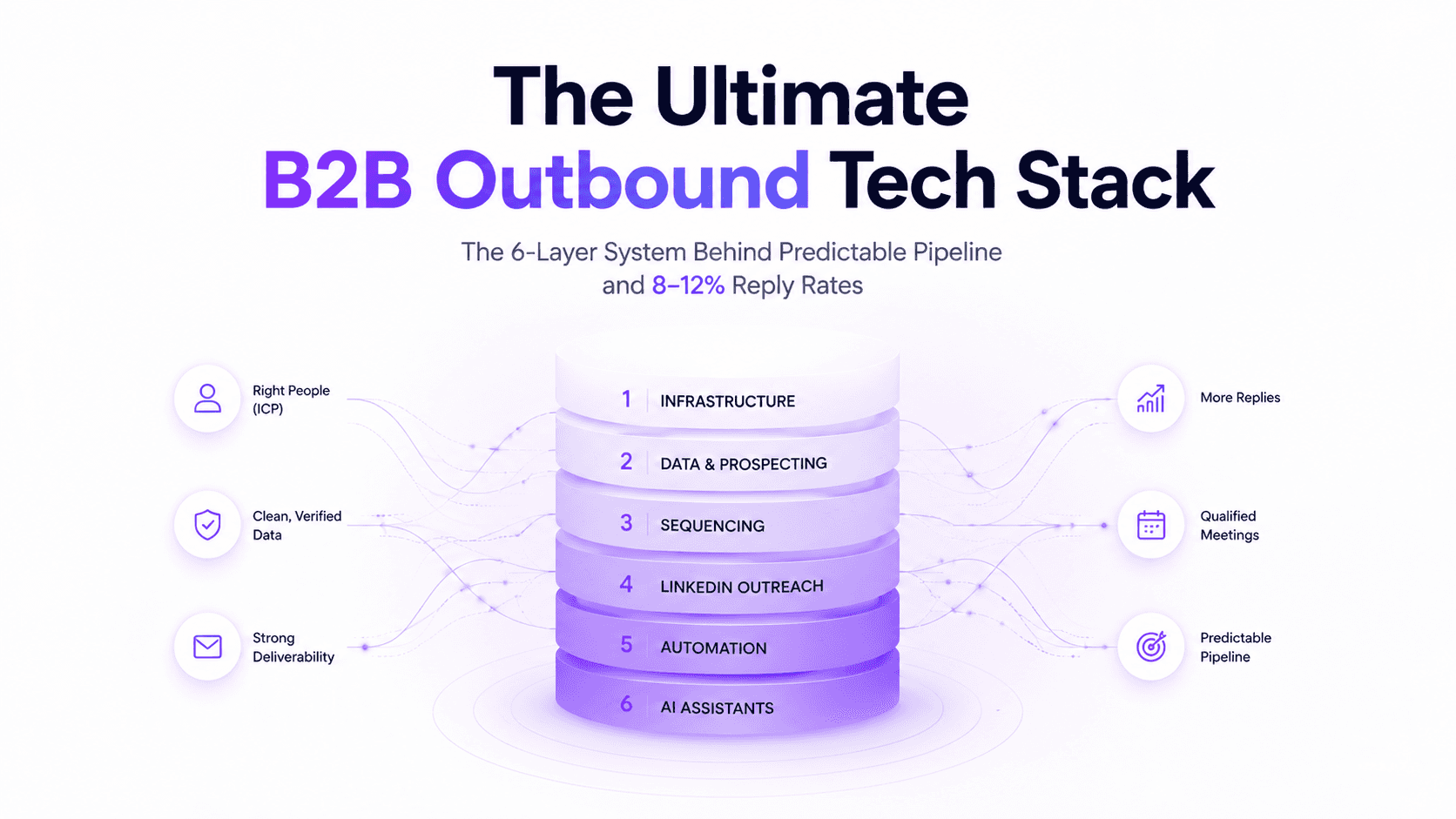
The teams booking 20, 30, and 50 qualified meetings per month are not doing more outreach. They are running a connected six-layer system where clean infrastructure feeds verified data, verified data feeds personalized sequences, sequences feed LinkedIn touchpoints, and automation ties every layer together. Remove any single layer and performance across the entire system drops.
The average B2B cold email reply rate in 2026 sits at 3.1%. The top 10% of outbound teams consistently hit 8 to 12%. That gap comes from system design, not effort.
This post breaks down the exact tools OutboundLeads uses across client campaigns, what each layer does, why it sits where it does in the stack, and how to build the same system at your stage and budget.
What Is a B2B Outbound Tech Stack (and Why Most Teams Build It Wrong)
A B2B outbound tech stack is the set of tools that covers every step of your outbound motion, from finding prospects and verifying contact data to sending sequences, automating follow-up, and managing replies.
Most teams build theirs wrong. They start with a sequencing tool before they have clean data. They skip deliverability infrastructure entirely and wonder why open rates drop. They add tools to solve symptoms instead of building layers that address root causes.
The right way to think about your stack is as a system with six layers. Each layer depends on the one beneath it. If any layer is broken, everything above it underperforms.
The 6 Layers Every High-Converting Outbound Stack Needs
Layer | Function | What Breaks If You Skip It |
|---|---|---|
1. Infrastructure | Email deliverability, domain setup, inbox health | Emails land in spam regardless of copy quality |
2. Data and Prospecting | Finding, enriching, and verifying ICP contacts | Wrong people receive your message |
3. Cold Email Sequencing | Sending, testing, and managing email campaigns | Low volume, poor analytics, no scale |
4. LinkedIn Outreach | Multi-touch LinkedIn automation | Missing 287% multichannel uplift |
5. Workflow Automation | Connecting tools, routing data, triggering actions | Manual bottlenecks kill execution speed |
6. AI Assistants | Copy, SOPs, research, and content at scale | Slow output and inconsistent messaging |
Layer 1: Email Infrastructure and Deliverability (The Foundation of Everything)
Most outbound teams treat deliverability as an afterthought. OutboundLeads treats it as the foundation.
The reason is straightforward: you can have the sharpest ICP, the most personalized copy, and a perfectly timed sequence, but if your emails land in spam, none of it matters. According to the Instantly Cold Email Benchmark Report 2026, 69% of cold email senders report declining performance year-over-year, with spam filtering cited as the primary cause.
Infrastructure is Layer 1 at OBL because it determines whether every layer above it works at all.
Why Are My Cold Emails Going to Spam? (The Real Causes in 2026)
Most cold emails do not land in spam because of bad copy. They land in spam because of infrastructure failures. The most common causes in 2026 are new domains with no warmup history, missing or misconfigured SPF, DKIM, and DMARC records, sending volume that spikes too fast, shared infrastructure carrying reputation damage from other senders, and purchased or unverified contact lists.
Every single one of these is an infrastructure problem, not a messaging problem. Before you rewrite your subject line, fix your foundation. See the full breakdown in Cold Emails Going to Spam: Why and How to Fix It.
Zapmail: Automated Email Infrastructure That Protects Sender Reputation
Zapmail automates the setup and management of cold email mailboxes across Google Workspace and Microsoft 365. It handles all technical deliverability configurations including DKIM, SPF, DMARC, domain provisioning, and outreach tool integrations, so outbound emails land in the inbox instead of spam.
At OutboundLeads, we use Zapmail to provision and manage real, authentic Google Workspace and Microsoft 365 environments for every client campaign. We do not use Google legacy accounts, EDU panels, or Azure workarounds. The difference in long-term deliverability is significant, and it shows in reply rates.
Zapmail core capabilities:
Automated DNS configuration (SPF, DKIM, DMARC)
Pre-warmed mailboxes ready for sending
Bulk mailbox and workspace management
Domain and workspace isolation
AI-assisted domain and mailbox naming
API access for scaling operations
Best for: Cold email outreach teams, agencies, and founders who need scalable, high-deliverability infrastructure without manual technical configuration.
For the complete infrastructure setup process, see How to Improve Email Deliverability for Cold Outreach: OutboundLeads' Framework.
BetterContact: Four-Layer Email Verification That Doubles Reply Rates
Clean infrastructure only works if the email addresses you are sending to are valid. This is where BetterContact comes in.
BetterContact uses multi-provider enrichment and four-layer verification to surface and validate email addresses before they are ever added to a sequence. According to 2026 cold email benchmark data from Cleanlist, verified email lists get 2x the reply rate of unverified lists, and 5 to 6 times the reply rate of purchased lists.
At OutboundLeads, we use BetterContact to enrich outbound lead lists and to enrich every single positive reply that comes in from campaigns, so our BDRs always have complete, accurate contact data ready for follow-up.
BetterContact core capabilities:
Multi-provider enrichment for maximum coverage
Four-layer verification process
AI sequencing support
Pay-for-valid-only pricing model
Layer 2: Data and Prospecting Tools (Where Most Pipelines Fail)
Once your infrastructure is solid, the next layer is data: finding the right people, enriching their records, and confirming every contact matches your ICP before a single email is sent.
Building a B2B lead list that converts is not a volume exercise. Campaigns targeting fewer than 50 tightly defined recipients average a 5.8% reply rate versus 2.1% for large, untargeted sends. Precision beats scale at every stage of outbound.
Clay: The Data Intelligence Layer That Powers the Entire Stack
Clay is the central nervous system of the OutboundLeads GTM stack. It connects to 100+ data sources to automate data enrichment, lead list building, CRM hygiene, and recurring data workflows.
We use Clay as the central data intelligence layer across every client campaign. It powers outbound list building, inbound lead enrichment, lead scoring, and recurring data refreshes. Clay feeds enriched, structured data into email sequencing tools, LinkedIn outreach systems, and CRMs to ensure every campaign runs on accurate, up-to-date information.
Clay core capabilities:
Recurring data workflows
CRM enrichment and hygiene
Targeted lead list building across 100+ data sources
Custom lead scoring models
Automated inbound lead enrichment
AI-powered outbound campaign data
Ideal for: Growth, sales, and RevOps teams who want to automate lead enrichment and build targeted lists with unique data and AI-driven insights. Trusted by teams at OpenAI and Rippling.
Apollo.io: The Supplemental Lead Source for Broad Coverage
Apollo.io gives teams access to a B2B database of 210 million contacts and 35 million companies with built-in outreach automation. At OutboundLeads, we use Apollo as a supplemental lead source and enrichment layer when additional data coverage is needed beyond our primary stack.
If you are building your first outbound system, Apollo is one of the best starting points. It combines prospecting, sequencing, and basic CRM functions in one platform, which reduces tool complexity at the early stage.
Apollo core capabilities:
Lead discovery across 210M+ contacts
Email and phone data
Campaign launching and sequencing
CRM integrations
Ocean.io: AI-Powered Account Discovery for ABM and ICP Targeting
Ocean.io is a B2B data platform that uses AI to organize over 35 million company profiles and 250 million LinkedIn profiles for precise audience building. Its core strength is lookalike modeling: feed it your best customers and it surfaces accounts with matching characteristics.
We use Ocean to identify high-quality accounts and contacts, run lookalike modeling, and build precise target audiences before enrichment and outreach begin.
Best for: Teams executing ABM, refining ICPs, and scaling outbound with AI-powered prospect discovery. If you have not defined your ICP with precision yet, the Ideal Customer Profile guide with examples and template is the right starting point.
Apify: Custom Web Scraping for Niche Prospect Data
Apify is a web scraping and automation platform that collects structured data from across the web. At OutboundLeads, we use Apify to gather business listings, social data, and niche datasets that feed enrichment, research, and outbound targeting.
When standard databases fall short for niche verticals or unique targeting criteria, Apify fills the gap with custom scrapers that pull exactly the data your ICP requires.
Clay vs Apollo: Which Data Tool Does Your Stack Need?
For many teams, the question is not Clay or Apollo. It is which one to lead with. Here is the direct comparison:
Factor | Clay | Apollo.io |
|---|---|---|
Primary function | Multi-source data enrichment and workflow automation | Prospecting database with built-in outreach |
Data sources | 100+ providers | Proprietary database |
Best use case | Enrichment, list automation, CRM hygiene | Fast lead discovery, early-stage outbound |
CRM sync | Advanced | Basic to advanced |
AI lead scoring | Yes | Limited |
Pricing model | Usage-based | Per seat |
OBL use | Primary data layer | Supplemental coverage |
For a full breakdown, read Clay vs Apollo: Which B2B Data Tool Builds Better Lead Lists.
Layer 3: Cold Email Sequencing (The Engine of Your Outbound System)
With infrastructure set and data enriched, Layer 3 is where outbound runs: sequencing, testing, sending, and managing replies at scale.
Before choosing a tool, understand where you stand against benchmarks. According to the Instantly Cold Email Benchmark Report 2026, the average cold email reply rate sits at 3.43%. Good campaigns hit 5 to 8%. The top 10% consistently exceed 10%.
If you are sitting below 3%, the issue is almost never copy. Read Why Your Cold Email Reply Rate Is Below 3% for the complete diagnostic.
What Is a Good Cold Email Reply Rate in 2026?
Performance Tier | Reply Rate | What It Signals |
|---|---|---|
Below 1% | Poor | Deliverability or targeting problem |
1 to 3% | Industry average | Generic messaging or list quality issues |
3 to 5% | Good | Solid ICP, decent personalization |
5 to 8% | Strong | High data quality, strong copy |
8 to 12%+ | Top 10% | Full-stack execution: infra, data, copy, timing |
EmailBison: The Deliverability-First Cold Email Platform
EmailBison is a private, deliverability-focused email sequencing platform built to run multi-step outreach campaigns with dedicated infrastructure. Unlike platforms built on shared sending infrastructure, EmailBison gives teams full control over their sending environment.
EmailBison is OutboundLeads' primary platform for running cold email campaigns. We use it to manage sequencing, replies, inboxes, testing, and performance across client campaigns while maintaining tight control over infrastructure and deliverability.
EmailBison core capabilities:
Dedicated sending infrastructure
Multi-step email sequencing
Built-in warm-up system
Unified inbox for reply management
A/B testing and campaign analytics
Unlimited workspaces and contacts
API and CRM integrations
Best for: Lead generation agencies, outbound sales teams, and SMB to mid-market GTM teams running high-volume cold email campaigns.
For sequence frameworks that convert, see 5 Cold Email Frameworks That Land Meetings and 15 Cold Email Templates That Generate 6 to 15% Response Rates.
Cold Email Platform Comparison: EmailBison vs Instantly vs Smartlead
Feature | EmailBison | Instantly | Smartlead |
|---|---|---|---|
Dedicated infrastructure | Yes | No (shared) | No (shared) |
Built-in warm-up | Yes | Yes | Yes |
Unlimited contacts | Yes | Plan-dependent | Plan-dependent |
A/B testing | Yes | Yes | Yes |
Agency workspace | Yes | Yes | Yes |
Pricing model | Flat plus usage | Flat | Flat |
Best for | High-volume agencies | SMB founders | Mid-market teams |
Layer 4: LinkedIn Outreach and Automation Tools
Cold email alone is no longer enough. Multichannel sequences that combine email and LinkedIn outperform single-channel outreach by 287%, and LinkedIn InMail averages 18 to 25% reply rates compared to 3.43% for cold email alone.
The teams consistently booking 30 to 50 meetings per month run both. Email and LinkedIn reinforce each other. A prospect who sees your LinkedIn connection request before receiving your email is significantly more likely to respond.
HeyReach: Multi-Sender LinkedIn Automation at Scale
HeyReach is a LinkedIn automation tool built for agencies, sales teams, and GTM operators who want to automate outreach across multiple LinkedIn accounts under one platform. It reaches 1,000+ leads weekly with sender rotation to keep activity within LinkedIn's safety parameters.
At OutboundLeads, we use HeyReach to scale LinkedIn outreach safely across multiple senders while syncing all activity into our GTM workflows and CRMs.
HeyReach core capabilities:
Sender rotation across unlimited LinkedIn accounts
Lead imports and campaign management
Unified inbox for all LinkedIn accounts
GTM integrations (HubSpot, Clay, Zapier)
Performance monitoring and analytics
Best for: Agencies, sales teams, and GTM operators who are serious about LinkedIn-driven outbound. Trusted by companies including Hyperight AB and B2B Boosted.
Twain: AI-Personalized Sequences for LinkedIn and Email
Twain is a LinkedIn and email outreach tool built specifically for agencies and sales teams. It replaces generic templates with unique, data-driven messaging sequences by using deep research and live-verified insights to personalize outreach at scale.
We use Twain to scale both LinkedIn and email outreach with high-quality personalization. It transforms enriched lead data from Clay into relevant, research-backed messaging that improves engagement across outbound channels, and integrates directly into our sequencing and CRM workflows.
Twain core capabilities:
Deep research for unique, non-templated message sequences
Live-verified insights with source attribution
Lead list building and expansion
Personalized message exports
Adaptive personas for different ICP segments
Universal API for stack integration
Layer 5: Workflow Automation and AI Orchestration
The tools in Layers 1 through 4 only compound when they are connected. Workflow automation is the layer that turns a collection of separate tools into a system: routing data between platforms, triggering actions based on behavior, and eliminating the manual work that slows down execution.
n8n: Logic-Heavy Automation for Technical GTM Teams
n8n is a flexible workflow automation platform designed for technical teams. It combines drag-and-drop ease with full coding power, supports self-hosting for data control, and offers over 500 app integrations.
At OutboundLeads, we use n8n for advanced, logic-heavy automations that connect systems, orchestrate AI workflows, move data between tools, and support custom integrations across our entire GTM stack.
n8n core capabilities:
Flexible AI workflow automation
On-premise or cloud hosting options
500+ app integrations
Code or visual workflow building
Debugging and re-run functionality
Make: No-Code Workflow Automation for Sales and Marketing
Make is a no-code platform for visual automation and AI orchestration with over 3,000 pre-built app integrations. It connects tools like HubSpot, Salesforce, Slack, and OpenAI without requiring any coding skills.
We use Make for fast, no-code automations across sales, marketing, and operations: syncing data between tools, routing alerts, managing task assignments, and running AI-assisted workflows that keep campaigns moving.
Make core capabilities:
Visual workflow orchestration
AI-assisted automation
Real-time monitoring and error handling
3,000+ app integrations
SOC 2 and GDPR compliance
n8n vs Make: Which Automation Platform Fits Your Outbound Stack?
Factor | n8n | Make |
|---|---|---|
Technical requirement | Medium to high | Low to none |
Hosting options | Cloud or self-hosted | Cloud only |
App integrations | 500+ | 3,000+ |
Custom code support | Full | Limited |
Best for | Technical GTM and RevOps | Non-technical sales and marketing |
Pricing model | Usage-based | Usage-based |
Most teams start with Make for simplicity and add n8n as automation complexity grows and custom integrations become necessary.
Layer 6: AI Assistants That Accelerate Outbound Execution
AI assistants do not replace outbound. They compress the time it takes to execute it well. At OutboundLeads, two AI tools operate at the execution layer: Claude for structured writing and content, and ChatGPT for rapid ideation and operational tasks.
For a full breakdown of where AI fits in the modern outbound motion, see AI SDR vs Human SDR: What Works in 2026.
Claude: Long-Form Copy, SOPs, and LinkedIn Content at Scale
Developed by Anthropic, Claude is a large language model built for safe, accurate, long-context reasoning and content generation.
At OutboundLeads, we use Claude primarily for copywriting, SOP creation, document processing, and LinkedIn content development, especially for long-form and structured writing. Its strength in maintaining voice consistency across long documents makes it the preferred tool for any writing task that requires precision and brand alignment.
ChatGPT: Rapid Ideation, Research, and Campaign Design
ChatGPT by OpenAI is a conversational AI assistant built for fast content generation, research, problem-solving, and workflow support.
We use ChatGPT across strategy, operations, development, and content workflows for ideation, documentation, analysis, and process design. For tasks that require speed, ChatGPT is the default starting point before refinement in Claude.
The Full OutboundLeads Tech Stack: How All the Tools Connect
Here is the complete OBL stack, organized by layer, with each tool's primary function and how it connects to the rest of the system:
Tool | Layer | Primary Function | Connects To |
|---|---|---|---|
Infrastructure | Email deliverability and mailbox management | EmailBison, CRM | |
Infrastructure | Email verification and enrichment | Clay, EmailBison | |
Data | Multi-source enrichment and list building | EmailBison, HeyReach, CRM | |
Data | Supplemental lead sourcing | Clay, CRM | |
Data | Lookalike account discovery | Clay | |
Data | Custom web data extraction | Clay, n8n | |
Sequencing | Cold email campaigns and reply management | CRM, Clay | |
Multi-sender LinkedIn automation | Clay, CRM | ||
LinkedIn and Email | AI-personalized messaging sequences | EmailBison, HeyReach | |
Automation | Logic-heavy workflow orchestration | All layers | |
Automation | No-code workflow automation | All layers | |
AI | Copywriting, SOPs, LinkedIn content | Sequencing, content | |
AI | Ideation, research, process design | All layers |
How to Build Your B2B Outbound Tech Stack by Growth Stage
Not every team needs all 13 tools on day one. Here is how to build the stack progressively as your outbound motion matures.
The Starter Stack: Under $500 Per Month
For founders and early-stage teams running outbound without a dedicated sales hire. Focus on the two layers that matter most: infrastructure and sequencing.
Zapmail for email infrastructure
Apollo.io for lead sourcing
EmailBison for sequencing
Make for basic automation
ChatGPT for copy and ideation
This stack is sufficient to run 300 to 500 outreach sequences per month with solid deliverability.
The Growth Stack: $500 to $2,000 Per Month
For teams with a repeatable outbound motion that need to improve data quality, add LinkedIn, and automate workflows between tools.
Everything in the Starter Stack, plus:
Clay for data enrichment and list automation
BetterContact for email verification
HeyReach for LinkedIn automation
n8n for advanced workflow automation
The Scale Stack: $2,000 Per Month and Above
For agencies and scale-stage B2B companies running multi-client or multi-market outbound programs.
Everything in the Growth Stack, plus:
Ocean.io for AI-powered account discovery
Twain for AI personalization at scale
Apify for custom data extraction
Claude for content production at scale
If you are weighing whether to build this in-house or work with a specialist, the In-House SDR vs Outbound Agency comparison breaks down the real cost difference and when it makes sense to switch.
What Top Outbound Teams Do Differently in 2026
The difference between teams stuck at 1 to 2% reply rates and teams consistently hitting 8 to 12% is not effort. It is system design. Three patterns separate consistent top performers from everyone else.
Multichannel Sequences Outperform Single-Channel by 287%
Teams running email plus LinkedIn plus phone touchpoints generate 287% higher response rates than teams running any single channel alone, according to 2026 outbound sales benchmarks from LeadHaste. The optimal sequence runs across 10 to 12 touches over four to six weeks for mid-market targets, and 12 to 18 touches over eight to twelve weeks for enterprise.
Verified Email Lists Get 2x the Reply Rate
According to Cleanlist's 2026 cold email data, verified lists get 2x the reply rate of unverified lists, and 5 to 6 times the reply rate of purchased lists. BetterContact's four-layer verification is the standard at OBL for every outbound list, without exception.
Smaller, Targeted Lists Beat High-Volume Blasts Every Time
Campaigns under 50 recipients average a 5.8% reply rate. Campaigns with 1,000+ untargeted contacts average 2.1%. Precision targeting with a well-defined ICP outperforms volume at every stage. See How to Generate High-Quality B2B Leads for the ICP targeting framework OutboundLeads uses across client campaigns.
And if your follow-up system is not as structured as your initial outreach, read How to Build a Scalable Follow-Up System With Real Outbound Data. Most meetings are booked on touch four or five, not touch one.
Frequently Asked Questions
What tools do B2B sales teams use for outbound in 2026?
Top B2B outbound teams in 2026 run a six-layer stack covering infrastructure (Zapmail, BetterContact), data enrichment (Clay, Apollo.io, Ocean.io), cold email sequencing (EmailBison), LinkedIn automation (HeyReach, Twain), workflow automation (n8n, Make), and AI assistants (Claude, ChatGPT). The tools matter less than how they connect into a unified system. A disconnected set of tools will not outperform a simple but well-integrated stack.
What is the best cold email tool for B2B outreach in 2026?
EmailBison is OutboundLeads' primary cold email platform. It stands out for its dedicated sending infrastructure, which protects deliverability at high volume. Instantly is a strong alternative for founders and smaller teams running lower volume. The best tool for your team depends on sending volume and how much infrastructure control your program requires.
What is Clay used for in outbound sales?
Clay is a data enrichment and workflow automation platform that connects to 100+ data sources. Sales teams use it to build targeted lead lists, enrich CRM records with multi-source data, score leads automatically, and run recurring enrichment workflows. At OutboundLeads, Clay is the central data intelligence layer that feeds every other tool in the stack with clean, current information.
How much does a B2B outbound tech stack cost per month?
A starter stack covering infrastructure, data, and sequencing can be built for under $500 per month. A full-scale stack with LinkedIn automation, advanced enrichment, and workflow orchestration typically runs $2,000 to $4,000 per month. Compare this to the fully-loaded cost of an in-house SDR, which exceeds $7,000 per month when salary, benefits, tools, and ramp time are included.
What is a good cold email reply rate in 2026?
The 2026 industry average is 3.1 to 3.43% according to Cleanlist and Instantly. Good campaigns hit 5 to 8%. Top-performing campaigns with tight ICP targeting, verified lists, and solid infrastructure consistently exceed 10%. Anything below 1% points to a deliverability or targeting problem, not a copy problem.
Do I need LinkedIn automation tools alongside cold email?
Yes, if you are targeting mid-market or enterprise buyers. LinkedIn InMail averages 18 to 25% reply rates compared to 3.43% for cold email alone. Multichannel sequences combining email and LinkedIn outperform single-channel outreach by 287%. HeyReach handles LinkedIn automation for agencies and multi-sender teams. Twain adds AI personalization across both channels.
What is the difference between n8n and Make for sales automation?
n8n is built for technical teams that need custom logic, self-hosting, and full code control inside their automations. Make is built for non-technical teams that want fast, visual automation across 3,000+ apps without any coding. Most outbound teams use Make for day-to-day automations and n8n for complex, logic-heavy workflows that connect multiple systems with conditional routing.
How do I improve email deliverability for cold outreach?
Start with proper DNS configuration: SPF, DKIM, and DMARC must be correctly set on every sending domain. Use dedicated mailboxes from real Google Workspace or Microsoft 365 environments, not legacy or shared accounts. Warm up every new domain before sending at volume. Verify every contact with a tool like BetterContact before they enter any sequence. See the complete OutboundLeads email deliverability framework for the full setup process.
What is BetterContact and why do outbound teams use it?
BetterContact is an email enrichment and verification platform that uses multi-provider data and four-layer verification to surface valid email addresses. Outbound teams use it because verified lists get 2x the reply rate of unverified lists. At OutboundLeads, it enriches both outbound lead lists and every positive reply that comes in from active campaigns, ensuring BDRs always have complete contact data for follow-up.
Is building an outbound tech stack worth it for a small B2B team?
Yes. A basic three-tool stack covering infrastructure, data, and sequencing under $500 per month outperforms most manual outbound efforts significantly. The ROI is not the tools themselves. It is the consistency and scale they enable. A well-built system running 300 to 500 sequences per month with proper targeting and deliverability infrastructure will outperform an unstructured manual outreach motion at any company size.
Ready to Build an Outbound System That Books Meetings Consistently?
OutboundLeads is a fractional GTM partner that builds and runs the exact stack described in this post for B2B companies. We handle infrastructure, data enrichment, sequencing, and LinkedIn outreach so your team can focus on closing.
If your current outbound is not producing consistent pipeline, or if you are starting from scratch and want to skip the trial and error, book a free strategy call. We will walk through exactly where your system is breaking down and what it would take to fix it.